Truth, Beauty: The Fly (David Cronenberg, 1986)
The art of the intellectual barf gag.
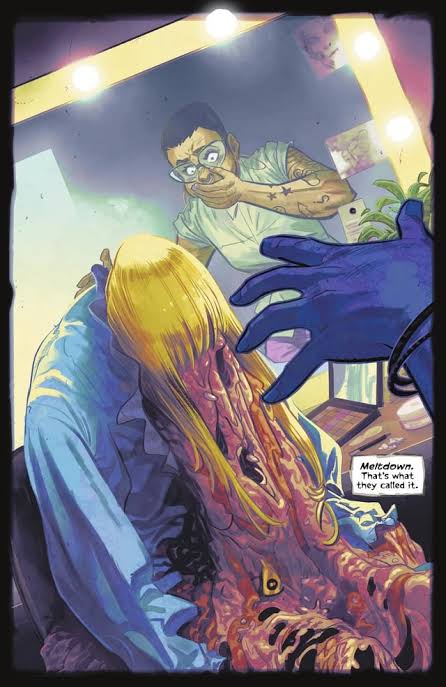
It's here. Clayface: Celebrity Dirt, my first-ever miniseries with DC Comics, is out today. You can get it at your local comic shop and the usual digital retailers.
While you're at the comic shop, remember to put in a pre-order for Issue #2, which has its FOC on Monday, July 20.
There are other announcements, but they can wait for next week. In the meantime, have another free movie post!
David Cronenberg is a poet among Goo Guys. His name has become synonymous with “body horror,” not because he was the first to do it, or the most extreme, or because it's the only thing he does — plenty of his movies don’t even qualify — but because he unites excess with purpose. He wants you to barf, but he wants you to think about why you’re barfing.
The Fly is the closest Cronenberg ever got to making a blockbuster, or even a standard Hollywood film. It capitalized on a trend of remaking 1950s monster movies with 1980s effects. (The Thing and The Blob, two other pinnacles of Goo Cinema, came out of this same moment.) Its plot is straightforward and linear in ways that, say, Videodrome never bothered to be. It centers around a star-making performance from Jeff Goldblum.
This is the Cronenberg movie you know, is what I'm saying, even if you don’t know Cronenberg movies, and while that would normally be damning something with faint praise — the one time David Lynch ever tried to make a blockbuster, he wound up with Dune — this is the rare big Hollywood sell-out movie that doesn’t actually compromise the director’s vision.
Cronenberg was made for The Fly, or The Fly was made for him; it’s a story about your body sliding out from under you, about youth and beauty and strength giving way to decay, about needing to be loved despite and throughout your physical degeneration. It’s a poem, wherein the condition of becoming a human fly stands for any number of things — addiction; disease; aging — and yet stands for only itself.
It was also released into a world where the idea of sex and beauty leading to death and decay, or young men wasting away in their prime and becoming unrecognizable, was very much part of the public consciousness. The Fly reads as a movie about any number of things in 2026, but in 1986, when it was first released, it could only be a movie about AIDS.
The confluence of body horror and the AIDS epidemic is a delicate subject. Over 100,000 people died in the US during the 1980s alone; by 1995, one in fifteen gay men under the age of 44 had been killed. These are the conservative statistics. The deaths of all those people are not primarily interesting, or important, for how they affected monster movies.
Still: Art always speaks to its time, horror included, and it is not an accident that body horror — like vampire movies, another 1980s specialty — came into its own as the AIDS death toll rose and rose. The gooey rubber monsters you see in these movies remind us of the insides and hidden functions of a body. They look like organs, like orifices; they ooze fluids that remind us of blood, of cum, of everything AIDS made it deadly to touch. They terrify us with the prospect of unshielded contact with a body at its most leaky, slimy, and contagious; they expose their insides, and threaten to contaminate ours.
Where something like Society just throws all that fear at the screen in hopes of overwhelming you — a valid and effective strategy, just to be clear — The Fly draws out the metaphor, handling the gross-outs with thought and subtlety.
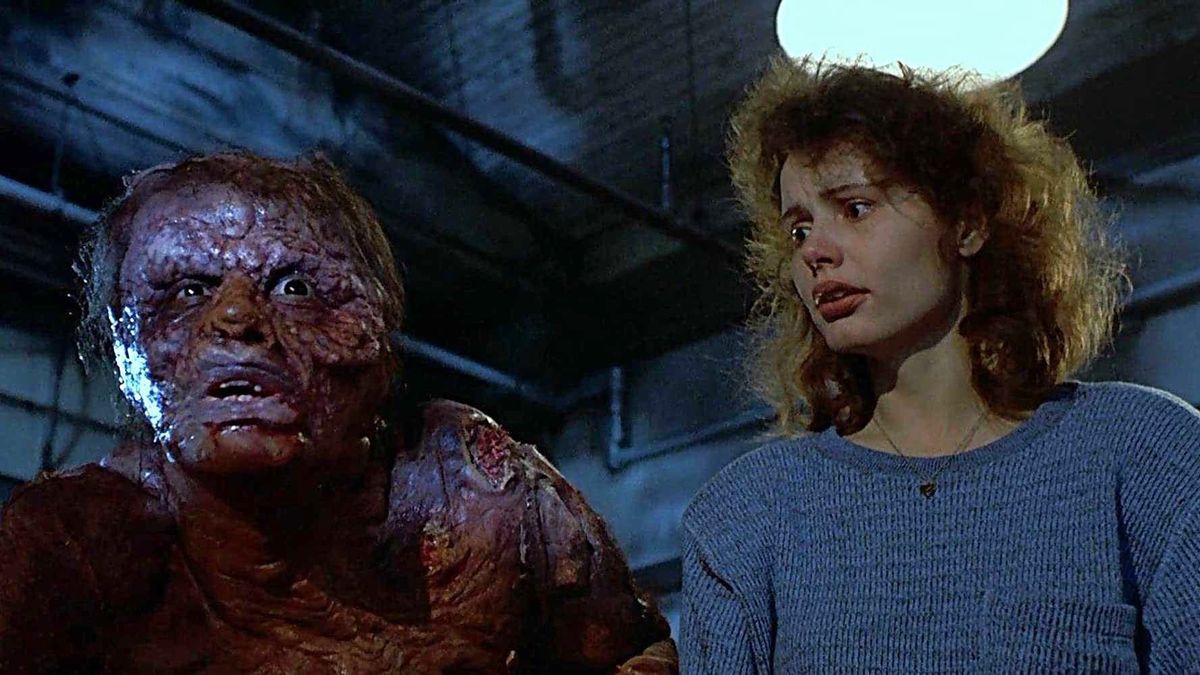
I haven’t mentioned the plot yet — this is one of those cases where I assume most people already know the basics — but, in case you need a refresher: Jeff Goldblum plays Seth Brundle, an incredibly hot and charming scientist who can’t stop exploding baboons in his various failed attempts to teleport them. When Brundle falls in love with the young Geena Davis — and who wouldn’t? — he is overtaken by the desire to impress her with his teleporting prowess, which is unfortunate, because he doesn’t have any. When Geena Davis has one (1) conversation with her ex-boyfriend, Brundle enters a drunken despair spiral, and puts himself through his own teleporter without checking to see if it’s empty.
It isn’t empty. There’s a fly in there. Thus, Seth Brundle emerges as “Brundlefly,” a man with the genetic code of a fly, who gradually mutates more and more toward his insect form as the movie progresses.
Geena Davis is truly in love with Brundle, for what it’s worth, and she has to go through the agony and grief of watching her boyfriend’s terminal illness and physical deterioration. She also has to deal with the possibility that he’s contaminated her — she’s pregnant, and she’s not sure if it happened before or after the teleporter accident. If it happened afterward, then whatever she’s carrying isn’t human.
This is another mid-1980s movie that lays out a surprisingly clear and unsentimental case for abortion. But the central question here is contamination, and what sleeping to a person with this disease can do to you. It’s about how much of him has gotten inside her; how engaging with his body has changed her body, and whether she can survive.
There are limits to how far the AIDS metaphor can take you here. For one thing, it means that Brundle’s heightened libido and tendency to try to drag women through the teleporter with him takes on a cruel and ugly connotation — one read of this movie is, undeniably, “AIDS victims are monsters,” which was something a whole lot of people believed in 1986. Still, there’s an underlying pathos that saves the movie from bigotry. Fundamentally, Jeff Goldblum is a young man who is dying; he’s angry, and he’s scared, and his body is changing in painful and terrible ways, and he wants more than anything for his partner to just not leave him. He made one drunk mistake, and it’s killing him, and he made that mistake because he fell in love.
I do not think The Fly would be the classic that it is if it came out in 2026 or even 2006. It’s the rare case of a filmmaker’s style exactly matching his moment — like any great popular success, this was about luck as much as anything else, a case of the right person telling the right story at the right time.
If body horror endures, as a genre, it’s because it has learned to tell new stories and use new metaphors. Vampire stories in 2026 are more often about queerness or the predations of a degenerate elite than they are about contaminated blood. (To be fair, they were always about those things — it’s just that the AIDS crisis kicked the blood thing into overdrive.) Body horror, similarly, has started to tell a lot of stories about beauty standards and gender identity, and some of my favorite movies are in that wave.
But Cronenberg is still the reigning great, the man whose name you think of every time you think about body horror, because he’s the one who taught us to put poetry behind our goo-monsters. He’s the director who could tell you a story about a guy who impregnates his girlfriend with a maggot the size of a golden retriever and turn it into a genuine human tragedy. He taught us that the scares and the gross-outs matter, but the intent behind them matters even more. When all the goo and lube and rubber falls away, there’s got to be some truth at the center of it; some beauty, inside the ugliness, before it all dissolves.
The Fly is available to rent on Amazon Prime and YouTube. If you want to hear me talk Clayface, you can catch me on Comic Book Club Live, the Cryptid Creator Corner, and (in a not-comics-related, yet delightful experience) back on Kill By Kill talking about the legendary Child's Play.
Here's a little goo guy:
Don't drink and teleport.