I Saw A Film Today, Oh Boy: Society (Brian Yuzna, 1989)
A crowd of people turned away, but I just had to look.
Welcome to July. It's a big month. We're headed into the series finale of Dead Teenagers – Issue 5 drops July 15 – and the trade paperback release of Be Not Afraid on July 7.
Even more importantly, Clayface: Celebrity Dirt (or, as approximately 50% of announcements called it, "Celebrate Dirty") is dropping its first issue on July 8.
Well: I, for one, do want to Celebrate Dirty. It may sound like an Andrew WK lyric poorly translated from the original Yugoslavian, but it also sounds like a good way to live your life. Therefore, I'm going to spend this month covering classic body horror, as God and Clayface intended.
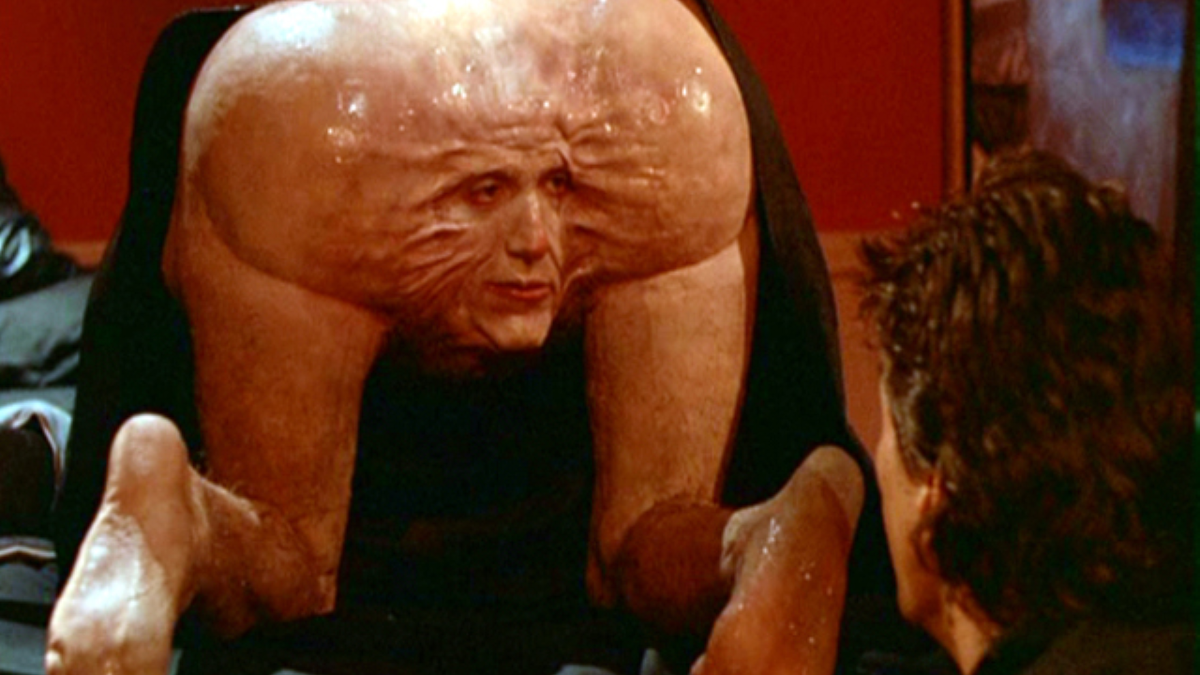
Society is many things — a B-movie; an act of class war; the only movie to ever actually make me throw up — but above all, it is a reminder that there was a time in Hollywood when your movie’s success depended on hiring the right Goo Guy.
“This was the era when horror movies were defined by rubber make up artists that kicked off with guys like Dick Smith and Tom Savini,” director Brian Yuzna told Fangoria, back in 2015. “You’d go into these effects shops and all the guys would be wearing black T-shirts blasting heavy metal and creating monsters. These were guys who came to Hollywood with two dreams: to either be a rock n roll star or make monsters for the movies. There was nothing else possible for them.”
This seems, among other things, like proof that there was literally nothing cooler than Los Angeles in the 1980s. The prospect of walking into a room full of long-haired, black-clad, leather-prone dudes, all blasting Motorhead whilst competing to make the goriest, bloodiest, grossest monster imaginable, fills me with bitter longing.
It’s also proof that the real stars of a movie are not necessarily on camera: Hollywood body horror peaked in the ‘80s, and those rubber monsters are why. The tactile, physical nature of the effects — you are looking at sculpture, not painting — triggers some inborn human instinct to avoid sticky or slimy textures. The monsters in The Thing or The Fly don’t look “real,” precisely, but they are very much in the room, heaps of real latex dripping with very real lube and glycerin. The look of semi-coagulated wetness reminds us of decay (think about the sliminess of an old piece of fruit, or rotting lunch meat) but it’s also uncomfortably sexual — like spit, like cum, like vaginal fluids — in a way that makes us recoil from unwanted intmacy. It impacts the audience on a gut level. It can (Society did, for me) literally make us sick.
The actors in these movies are interchangeable, the scripts are bad, even most of the directors were never exactly A-list, but the makeup and effects guys were and are legends. The legend responsible for Society is Screaming Mad George, a guy so iconic in his native Japan that they let him design his own restaurant. (The first thing you notice, looking at pictures, is that it would be impossible to keep down any food.)
This one's a bit gross (but also amazing), not sure if I can spoiler images on Twitter?
— Evan Collins | BLM 🏳️🌈🇵🇸 (@EvanCollins90) December 2, 2021
Found the first pic in this book; led me to these others, designed by the legendary SFX artist 'Screaming Mad George' (Joji Tani) -- this was an actual restaurant called 'Paranoia Cafe'! pic.twitter.com/pnwAstCrss
Society is the peak of Screaming Mad George's work, and therefore, the peak of Goo Guy Cinema. There are more famous body horror movies, and better body horror movies, but nothing quite as overwhelmingly repulsive as this movie. I feel bad recommending that people watch it — it will stay with you, even if your lunch won’t — but if you want to study the genre of body horror, or know what it can do, there is no version of it that doesn’t start here.
So: Let’s talk about the movie. Society is the tale of a young idiot named Bill (played by the delightfully named Billy Warlock) who is beginning to suspect that he’s adopted. Bill(y Warlock) belongs to a family of great wealth and privilege, but his parents strike him as sinister in ways he can’t quite pin down; his frequently naked, uncomfortably friendly sister is about to enter “society” at her first debutante ball.
More specifically, society is about to enter Billy’s sister. In an audio tape of the “ball,” obtained by the sister’s ex-boyfriend, Billy hears what appears to be a very loud and gross orgy, which features his sister’s enthusiastic participation. Both of his parents are involved in the Billy’s-Sister Sex Party, and their involvement is (let us say) intimate. Somewhere in the background of all the slimy, glorpy, incestuous sex noises, Billy hears a man screaming.
Now: Let’s say that you are Billy Warlock in this situation. Let us moreover say that the man who played you this tape disappears under mysterious circumstances directly after playing it for you. Which of the following extremely dangerous and stupid reactions do you have?
(A) Run around telling everyone that your parents are involved in a depraved incestuous sex club and that you’re going to get to the bottom of this.
(B) Directly confront your parents and their friends about their depraved incestuous sex club at a gathering where they vastly outnumber you.
(C) Begin a passionate affair with a mysterious young woman who seems to have ties to your parents’ depraved incestuous sex club.
Trick question! Billy Warlock does all of this, to predictably bad results. Before long, Billy has been trussed up and tossed into the center of an event known as “shunting,” and this is where the movie grows its horrid little wings and learns to fly.
It turns out, you see, that Billy is adopted. It also turns out that all rich people are secretly aliens, who feed off the organs of the poor, an act from which they derive intense sexual gratification, and that Billy was adopted specifically so that his parents could gang-rape and/or eat him with all their friends once he came of age. To familiarize him with the concept, they gang-rape and/or eat one of his friends in front of him, an act in which their true alien anatomy is revealed, and it turns out they can melt their flesh directly into the flesh of the person they’re eating and/or fucking, and furthermore into each other, thereby becoming a room-size tapestry of orifices and phalli and organ meat and blood and skin and lube (so, so much lube) and…
Look, man. The word “indescribable” gets thrown around a lot, but it has rarely been more apt than it is here. The shunting sequence takes up, roughly, the last thirty minutes of the movie, but it’s the only thing you’ll recall when the curtain falls; you will not, unfortunately, be able to un-recall it.
Society has had a revival in popularity as its anti-capitalist politics have become more common. There are Jacobin articles about it. People throw around comparisons to Eyes Wide Shut and the Epstein files, both of which are apt. Yet the idea that the rich are sadistic sexual predators who derive gratification from killing the poor has been around (in fiction) since Dracula, and (in life) since Elizabeth Bathory and Gilles de Rais. It’s not the concept that makes this movie. It’s the execution.
Society’s shunting sequence is like the final orchestral build in "A Day in the Life;" it just keeps escalating and escalating, to and beyond an impossible-seeming threshold. Whenever you think there’s nothing grosser that could happen, whenever you’re sure there’s no act of bad taste worse than what you’ve already seen, some new and even more horrible depravity gets introduced. Is it enjoyable? It’s not meant to be. Is it impressive? As a technical achievement, or an instance of someone committing to the vision, absolutely yes.
It’s Screaming Mad George’s vision. Brian Yuzna has made some great horror movies — Re-Animator and From Beyond are both classics — but he’s made them by choosing the right collaborators and getting out of their way. In the case of the former two movies, it’s about letting famously weird actors Jeffrey Combs and Barbara Crampton get freaky with it; in the case of Society, it’s letting Screaming Mad George do what he does.
There's a lesson in here for those of us in collaborative mediums – if you script comics, for example, you might be Yuzna, but your artist is going to be Screaming Mad George – but also for anyone who cares about art, and the conditions under which people make it.
The horror effects you love most weren’t made by overworked, burnt-out, nameless employees at a digital effects studio. They definitely weren’t made by entering a prompt into AI. They were made by freaks who spent hours handling latex and paint and glycerin, working it with their hands, until they created something unforgettable. They were made by people who loved making monsters, who would rather make monsters than do literally anything else with their lives, and it shows.
Love like that carries. Love communicates, no matter what it's for. You can't make anything good without it. That's the thing to take away from Society, or from this era of filmmaking: Whatever you do, whatever you make, it only works if you put every part of yourself into it.
But not, like, this kind of “put yourself into it.” Don’t do the shunting. It’s really gross.
Society (1989) floats around on free streaming sites, but it's pretty hard to find these days. This may or may not be a good thing.
At my other job: Non-Fiction Jude has been taking a back seat for a while, but you can find him in Liberal Currents' Reconstruction Papers, talking about life after patriarchy.
Like this, but for blowing chunks.