Problematic / Straight / Woman
Sorry about this, everyone.
Dead Teenagers #3 is still at your comic shop and the usual digital retailers. Dead Teenagers #4 will be here June 17.
DILF: Did I Leave Feminism is still available, in both book and smell form. You can also pre-order Be Not Afraid, which will be out in collected edition in July.
Final order cut-off for Clayface: Celebrity Dirt #1 is June 15. Get 'em in now if you want the goop.
Finally, as many of you know, I come from a large and supportive family, who often read my work. This is a note for them:
If you read this post, I will die.
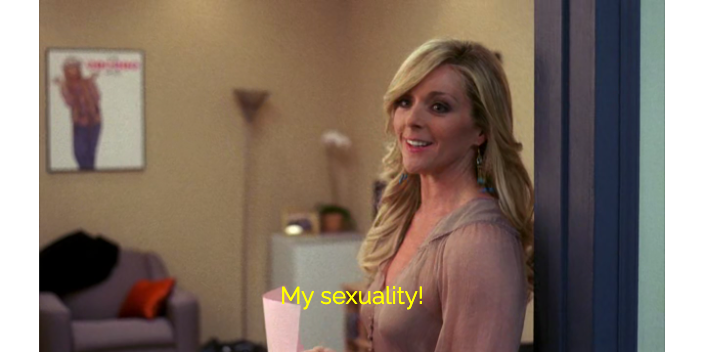
I'm very serious. Doctors have diagnosed me with a rare disease in which, if any member of my extended family reads this blog post – which is about my sex life, and my sexual identity, and which opens with a screencap of Jenna Maroney from 30 Rock saying "my sexuality," just to make its subject matter perfectly clear – my skeleton will literally ignite and melt the flesh off my body, Raiders-of-the-Lost-Ark-style.
Needless to say, dying from Raiders of the Lost Ark disease would be terrible for me, and also for you, because you would have to explain to my mother why you chose to kill me by reading the adult subject matter in this blog post. If you are my mother, you would probably feel even worse, so I wouldn't chance it.
If you read this post, I will die. Do not read it. I love you all.
I began writing this for a lot of reasons, but mostly because of one shot in The Testament of Ann Lee — the Amanda Seyfried musical about Shakers, which, by the way, is good. The shot I am talking about is one tiny moment: It’s the morning after Ann Lee has issued her proclamation that the Shakers will have to abstain from sex and emigrate to America. Ann Lee’s brother and follower, William Lee, wakes up next to a man in bed. Both are
Are you a member of my family? Did you try to read this blog post? I'm dead now! I died, because you killed me.
Please honor my memory by not reading this blog post.
I began writing this for a lot of reasons, but mostly because of one shot in The Testament of Ann Lee — the Amanda Seyfried musical about Shakers, which, by the way, is good. The shot I am talking about is one tiny moment: It’s the morning after Ann Lee has issued her proclamation that the Shakers will have to abstain from sex and emigrate to America. Ann Lee’s brother and follower, William Lee, wakes up next to a man in bed. Both are naked.
This shot is beautifully composed, and the actors are handsome, but it’s not salacious: Every part of the image moves the story forward. We now understand why William is willing to give up sex — carrying this desire around in an 18th-century Christian church would not be easy — and we also understand the sadness of the moment, and the sacrifice he’s making. William will never see this man again; he will never be with this man, or any man, again; he was not able to leave without spending one last night in his bed.
Every moment we spend with William, for the rest of the movie, will be informed by this image: His willingness to leave, what he’s leaving, and the fact that he couldn’t resist casting one last glance over his shoulder — like Lot’s wife; like Orpheus — at all that he would lose.
I thought about this shot for days, often enough that it became mildly and then severely embarrassing. What it came down to, I realized — late in the game, but I did realize — is that I am a man, and I am in love with another man, and this perfectly ordinary thing, two men waking up after a night together, is something I have experienced countless times, but I have almost never seen it in a movie. That one little moment of peace, what happiness looks like in my life, looks like nothing in the wider culture, because I don’t see it.
Complaining about Gay Representation in 2026 is a little stale — it’s absolutely true that we are much better off on that front than we were in the 1980s and 1990s, when I grew up. It’s also true that, even back then, there was plenty of Gay Representation that I didn’t see. I feel a shock of recognition when I see two men together, something vulnerable and awake and painful, and I have spent most of my life being ashamed of that reaction, and trying to avoid any media that might set it off.
Because the word for that reaction — for the kind of relationship I am in, and that I have spent my whole life in, by some measures — is “gay.” And I can’t be gay, actually. Because “gay” doesn’t just mean a pattern of attraction: It means a history and a culture and a duty of solidarity, it means a community and a language and a body of shared experience that I just don’t have, and that I will probably never have, given my age and my situation. Becuase “gay” implies a very specific, often lethal form of persecution that none of my relationships have been subject to, except for this current one, and even that started out differently. Because, well, look at me; tell me why any gay man, who is attracted to masculinity and men and male bodies, would be attracted to me, looking the way I do.
You can’t. I can’t. I can’t be gay, because no-one is ever going to see me as gay; they’re going to see me as a confused and problematic straight woman. Calling myself “gay” is only going to offend and alienate real gay men, it’s going to make them angry at me and make them laugh at me, and I can’t go making other gay men mad at me, so I can’t be gay.
But I am.
After my Testament of Ann Lee crashout, I decided to become an expert in Gay Cinema. I just needed to get over my self-consciousness, I figured; I needed to marinate in images of queer men being together, or just being queer out in the world, until it stopped seeming like a forbidden glimpse of a life I’d never been allowed to have and started seeming normal.
I really did watch a lot of capital-G Great Movies, as the result of this. I watched Querelle (beautiful!) and Beau Travail (haunting!) and Cruising (problematic! but also hot!) and Happy Together (life-changing! revelatory! a literally perfect film!). I will be talking to you about none of those Great Movies today, because in the middle of watching them, I was also stupid enough to watch Heated Rivalry on HBO.
The Internet is awash in Heated Rivalry discourse. I promise that I will not add much more to it. What you need to know for the purposes of this argument is that Heated Rivalry is a very popular show with a lot of gay sex scenes, and that it has generated a whole lot of jokes like this:
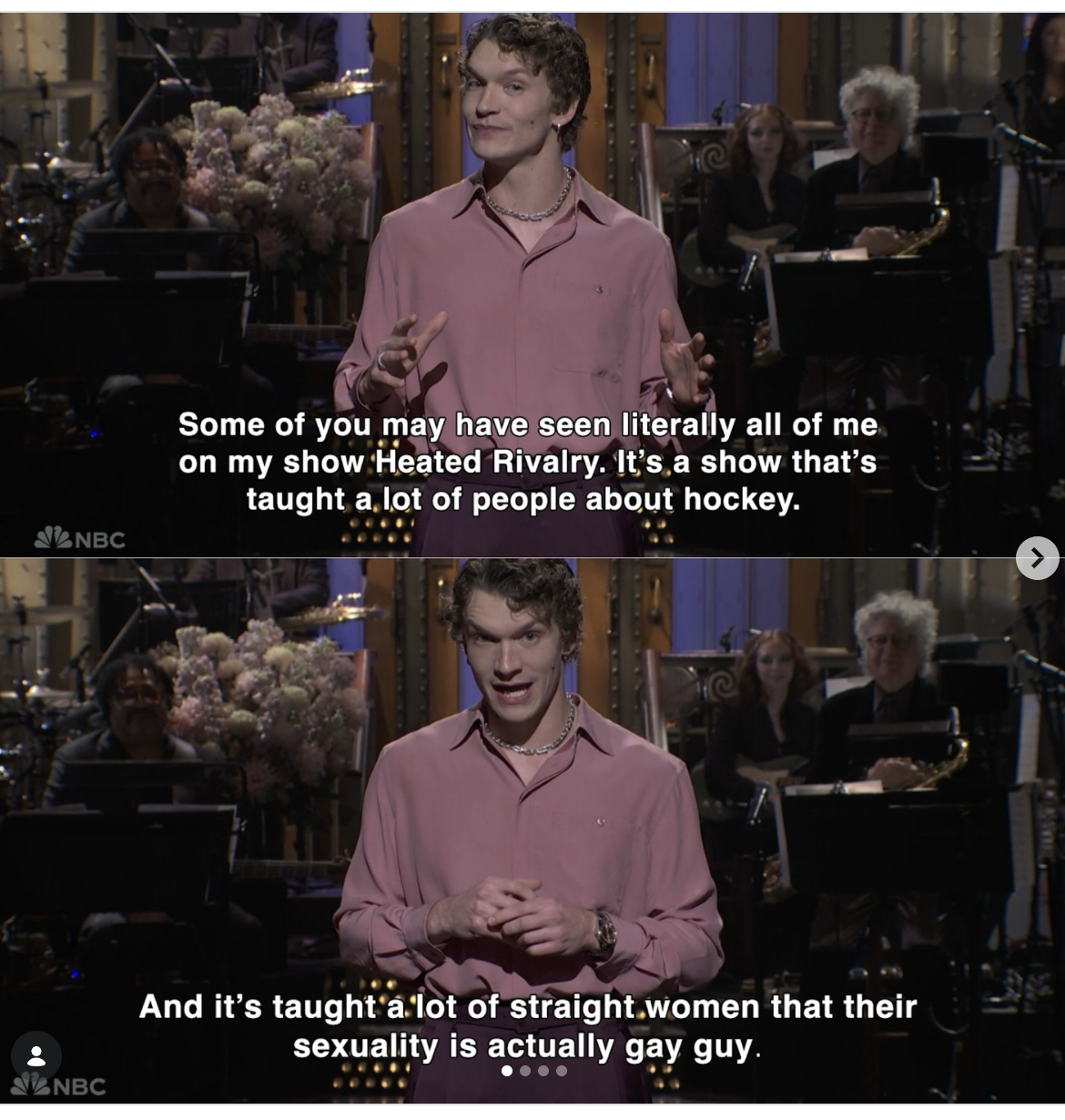
The fujoshi-to-trans-guy pipeline has been extensively discussed, to the point that some trans people now apparently find it boring. These appear to be the same trans who find any form of queerness boring after it spreads beyond them and their five best friends and the 47 separate post-graduate degrees they share between them, but sure: We all know, from reading Gender Queer or talking to our friends or just spending time online, that a lot of transmasculine people figured out their sexuality and/or gender by reading slash fic or MLM romance or yaoi. We also know that these genres are primarily made by and for women.
The border between a woman who gets off on gay men and a “woman” who is a gay man can be porous and blurry. It can also be substantially more painful than that SNL joke might lead you to believe. I didn’t learn about gay sex from fanfic; I learned about gay sex from dreams about sex with other men, which I had at regular, distressing intervals from the time I was 12 years old. When I learned that one could read about or watch that kind of sex online, sure, I looked at it, if only to see how accurate my guesses were — but I very quickly stopped looking at it, for the reasons I’ve already outlined.
For me, the knowledge that some women got off on gay dudes was not liberating. From that point forward, I had the understanding that my sexuality was a fetish — not even a normal, harmless fetish, like shoes or getting tied up, but something exploitative, predatory, something that feasted on the marginalization of others for my own benefit. It was a bachelorette party at a gay bar with perv intent, the gender-flipped equivalent of some guy leering over two girls at a party and daring them to make out.
Boring as that might be, the shame does stay with you. Because here’s the thing: I do, actually, think that Heated Rivalry has a weirdly heterosexual take on its gay relationships, at least sometimes. This is partly because it’s romance, a genre that has historically been shaped by the female gaze, NOT THAT THERE’S ANYTHING WRONG WITH THAT (please don’t hurt me). But it’s also true that nearly every gay relationship I’ve seen on TV recently — Schitt’s Creek, Our Flag Means Death, Unbreakable Kimmy Schmidt, this — features one guy who’s never had sex with a man before, who then has to learn he’s gay due to the ministrations of a somewhat more experienced gay dude, and this relationship is romantic and monogamous and implicitly expected to last forever. We’ve got a generation of fictional gay men who are doing the equivalent of marrying their high school girlfriends, and I can’t see it as anything other than an attempt to downplay the threat of gay sexuality or “promiscuity:” The story takes pains to show us that these guys are gay in the sense of being in love with exactly one other man, not gay in the sense of liking to fuck and get fucked by dudes.
More than that, the dudes on Heated Rivalry are gay men who don’t have anything to do with being queer: They’re all straight-passing. None of them are out. None of them have gay friends or a connection to queerness as a politic. (Well, one guy is out and has gay friends — and the fandom hates him.) Their most pressing issue is whether they, personally, can come out of the closet without harming their careers, and while that is definitely a dramatic chapter in any queer person’s story, it also just seems played out as a trope. In my experience, queer people typically have full and interesting lives after self-accepting, but on TV, they don’t do much more than get stuck in closets and come out of them.
I’m not out picketing the show. If you like it, watch it; the sex is hot, the dudes are cute, I found parts of it moving. But Happy Together — a literally perfect film! Anything would suffer by comparison! — was made thirty years ago, by a straight person, and there’s nary a bit of closet drama in it. It’s just a love story about two men who desperately want to be together, and who also can’t be together, not because they’re gay, but because of who they are. Wong Kar Wai doesn’t milk queer oppression to make the romance feel forbidden or tragic; he just serves up a tragic movie about two men in love and lets us deal with it. Telling gay stories as stories, depicting gay people as people; that’s what I’m asking here.
And here’s where the panic kicks in, because, really: Who am I to be asking anything on behalf of gay people? How am I sitting here, talking about the female gaze and problematic fujoshis and how gay men typically get to be gay with more than just one person, when I have been married to the same man for sixteen years, and he is also the only man who’s ever had sex with me knowing that I’m a dude? Everybody else gets to have a hot take on Heated Rivalry. I get to know that even watching it makes me secretly a woman, and therefore a straight person, and therefore a creep and a monster.
Where do I get off? Who do I think I’m fooling? The nerve of me, the nerve, the arrogance, the raw presumption: How do I get to tell actual gay people what it’s like to be gay?
But I am.
“Middle-aged white man panics about being gay” is not a tremendously productive genre of essay, and I would forgive you if your eyes glazed over a bit, contemplating this one. But that’s precisely it: I’m not panicking about being gay. If I could be easily, unambiguously read as homosexual, I would be a great deal more confident and at peace with myself. I’m panicking about being read as straight, or about being straight, about my sexuality unraveling my gender until all I’m left with is a series of things that I’ve failed to be.
I’ve tried to be something else, something more convincingly queer-sounding. My Wikipedia page still says I’m bisexual. Part of me still thinks that is correct, that there might one day be an unlikely set of circumstances that aligns to put me in a relationship with a woman. The truth, though, is that I’ve been open to dating women since high school, and circumstances just keep on not aligning. I love many women as human beings; I typically prefer to be friends with women; I’ve had sex with women; I’ve been attracted to some women from a distance. But when that distance closed, and things got physical, something just didn’t ignite.
I needed it to ignite, so I kept trying. I grew up in an era when the standard consensus about trans men was that they were lesbians who were just so intensely lesbian that they crossed some mysterious event horizon and became dudes. Even the more evolved, trans-guy-centric material told me that Trans Men had Always Been and Would Always Be Valued Members of the Lesbian Community, without mentioning that these terms and conditions might not apply if you were a giant homo. One way or another, I got the message: If I couldn’t be a lesbian then I also couldn’t be a trans man, and I kept trying to wedge myself sideways into the proper trajectory without success.
I tried to tell myself that the problem was psychological: Maybe I was repressed. Maybe I was nervous. Maybe casual sex — which I did to avoid breaking anyone’s heart or leading them on — wasn’t the right move, and I would warm up more if I trusted the other person. Maybe I just needed a deeper emotional connection.
Maybe. But the fact is that on my least mentally healthy day — and especially on those days, in fact! — I enjoy sex with men. I can enjoy sex with men I don’t know. I can enjoy sex with men I don’t like. I can enjoy sex with men who don’t like me. I delayed transition, for decades, to make sex with men more possible.
If I was able to make Sex With Men a priority under all those circumstances; if, despite unemployment and breakups and work stress and trauma and dysphoria and depression, Sex With Men still happened; if I was able to survive 9/11 and the war in Iraq and the Great Recession and two Trump presidencies while still finding time to pursue the abiding passion, art form, and semi-competitive sport that is Sex With Men, well: Maybe I just like having Sex With Men, and that’s it. Maybe this romanticized idea I have about Sex With Women — in which we, I guess, stare into each other’s eyes and respect each other so darn hard it brings us both to climax — is just me being sexist, and sexuality is defined by the sex that works.
And if I am a man, and if the sex that works for me is Sex with Men, and if sex with anyone who is not a man doesn’t really work, well… would we use the word “gay” to describe this, maybe? Might that not be a workable term, for the man-who-really-likes-sex-but-only-with-other-men phenomenon?
Not according to Glenn Greenwald, it isn’t. By the time I’d been out for a few months, there was already a video blasted out to millions of people about “straight people" in “straight marriages” claiming gay identity, and how this was victimizing real gay men like Glenn Greenwald, who had actually had to fight for their marriages, and I was one of the primary named examples of the phenomenon. So, no: not according to Glenn. Not according to the people who watched his video. Not according to the edgy gay guys calling me “this girl” and laughing about how I thought cutting my hair had turned me into a man. Not according to the anonymous hate mail about how I “don’t pass” and anyone who tells me otherwise just feels sorry for me. Not according to the Reddit threads expressing scandalized pity for my husband, who now has to “pretend he’s gay,” and pretend he’s attracted to me, to keep his mentally ill wife from going off the deep end. Not according to me, either, because I’ve heard from all those people often enough that some vicious part of my brain will always speak in their voices rather than my own.
For well over a year after my transition, I kept trying to convince my husband that he was straight. I kept telling him that it was okay to leave, that we didn’t have to be monogamous, that it would be okay for him to go have sex with women, that I didn’t want him to be trapped, that I knew he was making a sacrifice, that he shouldn’t have to do that. He told me, over and over, that he was attracted to men; that he’d always been attracted to men; that some part of his attraction to me had always been about me being a man, and that going on testosterone or getting top surgery hadn’t changed me, it had just brought the parts of me he was attracted to more into focus; that I had done us both a favor.
He did and said everything a supportive partner was supposed to do and say, and I just sat there, giving him stinkeye. A normal person might have concluded that he wanted to be with me. I did not. I decided that he only wanted to have sex with me because he still saw me as a woman, and this would come up, at regular intervals, every time I felt even a little insecure, which was always. Any attraction he displayed for me post-transition just fueled the elaborate mental torture scenarios in which he was cheating on me with a past version of myself. I heard everything he said, but I still chose to listen to the Reddit people. What the Reddit people said was meaner, so it was easier to believe.
What I’ve just written is a record of internalized transphobia, and probably internalized homophobia. It doesn’t represent what I actually believe, although someone is probably screencapping it as we speak. I know that there are other gay trans men on the planet, that most of us are some kind of queer if you trust statistics, and that these other gay men have written books or hosted podcasts or YouTube channels, the content of which is enlightening and wholesome.
I know all those things. But the knowledge lives up in my head, in the part of me that thinks; it doesn’t filter down to my gut, to the dark cell inside where I know that I am the only person who has ever had the misfortune to be both gay and transgender. So this is not about being enlightening and wholesome. This is about me being uncomfortable, and making you uncomfortable, because I would like you to think about what that’s like: To assume that the meanest thing you can believe about yourself is always the most true thing. To know that people will always believe the worst of you, so you had better find some way to get there first, and believe it harder, to keep yourself in check.
I would like you to think about that, because the truth is, after a while of this — after years or decades spent knowing that you were the only thing of your kind, after a life of presuming that your existence was just fundamentally offensive — you would be willing to make considerable sacrifices to make people accept you. You like men; women are supposed to like men; you’re supposed to be a woman. Right? So you would decide to just be a woman, to choose between two equally impossible truths in a way that made you straight.
You would do that, and then you would find out that it was impossible. I enjoy sex with men. I enjoyed it before my transition. But I had to find ways to make myself enjoy it. When things got too close, when the reality in my head and the reality in the room started colliding, I would step out of my body; I would retreat back into my mind, where things were safe, and everything worked the way it was supposed to. It didn’t feel tragic. No-one ever noticed me doing it, and I didn’t know that it was possible to do anything else. I gave the other person what they needed. I gave myself what I needed. But I gave it to us both separately; I wasn’t having sex with the other person, I was having sex near them, in a way they happened to like.
Sex With Men was the moment I felt most alive and closest to myself. But right before I became real, right when I almost had everything I needed, a wall would slam down, and I would hit it at 5,000 miles per hour. It was like getting a bag of chips stuck in a vending machine for twenty years. You put your change in, you press your button, and: Nope. Except it’s worse than that, because that one bag of chips is the only thing you’re actually able to eat, somehow, and you hit the glass over and over and it just gets even more stuck each time, and it turns out you can live on the verge of starvation for an indefinite amount of time without actually starving. It starts to change you. You start to turn angry, and mean, and you start to take risks that you know are risks, and you slowly begin to hate everyone around you, because they get their chips without even pressing a button, they’re eating perfectly fine, those fucks.
Maybe you could live like that. People do. Maybe, if you didn’t know anything else was possible, you’d just bang on that glass indefinitely. But the truth is, if you ever let your guard down with even one other person — if you ever had sex as yourself with someone who actually wanted you to be that guy — you would realize what it’s actually like to be with someone. From that point forward, everything else would be inevitable. If you’ve been alive once, for even a moment, you can’t give it up.
I really am just desperately in love with him, is the thing. The husband; the guy I married. It may seem odd that I’ve worked my queer identity out in the space of one marriage — one monogamous marriage, no less — but I would caution you against assuming that a marriage is a small place.
You can have a lot of relationships over the course of one relationship. There will be times when you coast on routine with each other, and times when you are too preoccupied with parenting or work to really hang out, and times when you are on each other’s last nerve and bickering about chore distribution, and then, suddenly, something will turn a corner, and there you’ll be: Falling in love, for what must be the fiftieth time, with the same person. It feels the same as it did when you were eighteen and kissed someone goodnight for the first time, wired and lightheaded and fizzing with excitement, wondering if you could possibly be lucky enough to see that guy again.
You always get to see him again. You get to have the best first date of your life, every day of your life, and you already know that you end up together, so you aren’t scared. It feels heavy and bright and tremendous; it reaches from horizon to horizon like a second sky.
It wasn’t possible before I came out. We had something, and it was good, but it wasn’t this. The first time I fucked a guy as a guy, eyes wide open, in my skin, not needing to be anywhere except exactly where I was in that moment, made love possible for me; it drew my heart to the surface of my chest so that he could touch it. Being gay is, sometimes, about being in love with exactly one other person. It’s also about fucking. It’s about learning that those two things can sometimes be the same.
So I tried to convince him he was straight, so that he would leave me. I tried to convince myself that it was noble and unselfish to make him leave, that I was freeing him, sparing him the burden of catering to my monstrous desires. Many people will tell you this, about being queer, but you will fuck up your own life until you believe it, so here’s one more repetition: Believing the meanest thing about yourself also requires you to believe the meanest possible thing about the people who love you. You cannot be good for even one other queer person if you are still doing hate crimes to yourself.
Back to The Testament of Ann Lee: It is easy to identify with William, in that scene. It’s easy to see it as his tragedy — how he’s going to get out of bed, do what God requires, advance the cause of religious liberty and civil rights and help Ann become a Powerful Trailblazing Woman and bury every raw, naked, ordinary part of him in the process of embodying a principle. It’s easy to see how much he wants the human tenderness he’s sacrificing; how he can’t leave without knowing everything he’ll lose.
But there is another man in that scene, and he is also losing something — not by choice, not for the sake of some grand principle, but because his boyfriend cares less about his feelings than he does about some abstract idea of Righteousness. Being kind to the people who love you is also righteous, and William is resolutely failing to do it. He’s so steeped in his particular suffering that he can’t see the pain he’ll cause.
All my worrying about being Bad for Gay Men only made me oblivious to the ways I might be hurting the actual, specific queer man I live with. I never paused to think that it might, actually, be a big deal for him to say — over and over again — that he was attracted to men, that he had always been attracted to men, that I was a man and he liked me for it. I didn’t think about the work it might take to for him to unlearn his own shame or re-arrange his own self-concept; I didn’t realize that he, too, had to cross a long and perilous distance in order to be real with someone. I certainly didn’t realize that responding to someone’s self-disclosure of queerness with hmmm, I’m pretty sure you’re straight, actually, was cruel, and that it was cruel in ways I, personally, had experienced — that sure, maybe I was doing it to him because the whole world was doing it to me, but inflicting harm on others after having suffered it is even less excusable than doing it from ignorance alone.
So I am trying to believe him when he says he likes me. After an all-too-brief trial period of sixteen years living together, ten years of legally binding marriage, and nine years spent raising our mutual human child, I am now ready to concede that he might be planning to stick around. Rather than focusing on how I may be harming the wider cause of Gay Rights, as they pertain to all gay men but especially Glenn Greenwald, I am trying to focus on my boyfriend, and his Gay Right to be with someone who isn’t a basket case. It is a small thing, but it’s the right thing, and he deserves that much.
I mean, let's be honest: Caring about what Glenn Greenwald thinks, in the year 2026, is way more embarrassing than having some weird fetish. So even though I do care, even though I will probably always care — I care what everyone thinks of me, as long as it's bad — I am trying to hear the other voices. Whether or not I believe I’m real, whether or not I believe I’m loved, isn’t the only question. I may never fully believe it.
But I am.
That's it. You can track my impending Gay Cinema Expertise here, if you like, or pick up a cheap subscription during Pride. Thank you for belonging to the crowd of Internet strangers who are the only people allowed to read this post.