Notes on Camp: Teenage Sex and Death at Camp Miasma (Jane Schoenbrun, 2026)

Before we begin, fair warning: This is a post about sex.
Before we continue, an even fairer, more specific warning: This is a post where I talk about how I have sex. I talk about my body, and how I feel about it, and how sex complicates my feelings about that body.
Before you read this post, ask yourself: Is it going to be awkward for you to know how I have sex?
- If you are my neighbor, it may be awkward for you to know how I have sex.
- If you are my coworker, it may be awkward for you to know how I have sex.
- If you are going to have to look me in the face at any point in the near future, it may be awkward for you to know how I have sex.
- If you are my family, including my mother, brother, aunts, uncles, or any representative or proxy of my mother, brother, aunts or uncles, it will definitely be awkward for you to read this post, because it's about how I have sex.
- My partner has already read this post, because it's his life, too, and he had to give it the green light. I'm not a maniac.
If it's going to be weird, skip it. The rest of you, proceed... if you dare.
1) I got my period on the way into Camp Miasma. I hadn’t gotten it for years, until I went off testosterone for a few months at the beginning of this year, and the reprieve made the experience all the more upsetting. Maybe I shouldn’t have gone off testosterone, and maybe I shouldn’t be telling you this, either. But if we’re talking about Camp Miasma, I want to start here: Flesh and fluids. The body and its blood.
2) The reasons I went off testosterone are complicated. It was partly about my inability to access care. I was experiencing odd side effects — fatigue, rapid weight gain, etc. — and I thought I might be on the wrong dose, that the T might be converting into estrogen in my body, which is famously what happens when you’re on too much. I didn’t need to stop, I needed to get the dose adjusted, but when I booked a telemedicine appointment, the Planned Parenthood was low on staff, and I wound up speaking to a nurse I’d never seen before.
“Testosterone… converting??? Back to estrogen????” she said, describing literally the most well-known side effect of a wrongly calculated dose of testosterone. “Oh, no. As far as I know, it doesn’t do that.”
I have dealt with doctors who are clueless about trans bodies before, but I had never had to deal with one who was actually administering my trans care, and so I thought, I don’t want to keep doing this without help, and I titrated off the T until I could find (I told myself) a better doctor, and when I realized that I couldn’t find one, and that I hated being off testosterone, and that even dealing with the most clueless cis person imaginable was better than not getting any care at all, the Planned Parenthood telemedicine program had gone from being understaffed and underfunded to being cut altogether. And they didn’t notify patients that it had been cut, and they also left the page up so you could still book appointments, so for a few months I kept trying to book appointments that mysteriously never happened.
In all that time, my period came back, and it was very distressing. But I am still cheating, still not being real with you, and my need to cheat, my inability to be real, is exactly why I wound up going off T in the first place:
3) I went off testosterone because penetrative sex had become intensely, physically painful and nothing else I tried would make it stop. This is the other well-known side effect of testosterone, and it finally caught up to me, to the point that I couldn’t ignore it any more. And even though I knew the name of the condition, which is ______ atrophy, and even though I knew there were medicines I could take so that I wouldn’t experience atrophy of my _________, asking for those medications would have involved saying the word ___________, out loud, and admitting that I had one, to a stranger, and furthermore it would have meant telling someone that my _________ does sometimes get involved during sex.
And I could not do that. I could not make myself do it, for the same reason I’ve never in my life booked an appointment with a gynecologist. For the same reason I said “prefer not to answer” every time Planned Parenthood asked me what method of birth control I was on. I just went off T instead, because admitting that part of my body existed and that it was connected to my sexuality would lead anyone who heard me to realize I wasn’t Really Transgender anyway. Wasn’t Really A Man. Wasn’t Really Having Sex the way Men Have Sex. Was a freak, was a fag, was a woman, and really, aren’t fag and woman the same thing. Isn’t that what you mean when you say pussy.
It all ended in blood, up at Camp Miasma. So that’s why I’m telling you this: Because a movie this intensely vulnerable deserves, even demands, a corresponding exposure of vulnerability from the viewer. Because I can’t ask someone else to put their body up on the table for dissection while keeping mine uninvolved.
4) The spear is a penis. Specifically, it’s Hannah Einbinder’s penis. Sometimes, it’s Gillian Anderson’s penis. Both women have them. There’s no explicit textual confirmation for this in Teenage Sex and Death at Camp Miasma, but in a movie entirely about sex, we are never shown what either woman looks like naked, only that they’ve had similar difficulties in experiencing sexual pleasure, and that their level of comfort with the spear (which is a penis) is the determining factor in whether or not they can get off.
To me, therefore, it seems obvious that this is a movie about learning to navigate sex as a queer woman with a penis. Gillian Anderson has learned to include, and even welcome, the spear as part of her sexual experience, and Hannah Einbinder has not, and Gillian Anderson teaches Hannah Einbinder how to allow the spear to play a role in her sex life without causing a shame spiral, which is very sweet.
Lots of layers here, and not sure I got it the first time around, reviewers are commenting on Teenage Sex and Death at Camp Miasma, but I think I got this one, actually: It’s about how some people are born with genitals that exist in seeming contradiction to their gender identity — a condition known as “transgenderism” — and how that is uncomfortable, given that you have to deal with those very genitals each and every time you have sex.
5) We might not actually be talking about Gillian Anderson as a lesbian with a penis here. (Which is a shame! We should do that more often!) We might be talking about me as a guy with a ______.
6) The plot, then: Teenage Sex and Death at Camp Miasma is a movie in which a young queer filmmaker (Hannah Einbinder) is hired to reboot a franchise called Teenage Sex and Death at Camp Miasma, which was directed by Ray Blanchard (I know, I know) and which starred a (teenage version of) Gillian Anderson. This movie franchise is most famous for being incredibly transphobic — the monster is a non-binary kid killed in a hate crime whose vengeful spirit comes back to slaughter “ordinary” teenagers.
Unfortunately, the (come on, she’s obviously) trans Hannah Einbinder’s sexuality is deeply tied to this transphobic movie. She had her first sexual feelings while watching Gillian Anderson in the original — specifically, a scene where the young Gillian looks up mid-sex to see the killer hovering over her with his upraised spear.
Gillian Anderson, no longer a teenager, is now an extremely glamorous (and obviously trans) recluse who lives at the abandoned summer camp where Camp Miasma was filmed. She’s immediately interested in having sex with Hannah Einbinder, who is likewise interested in having sex with her. I honestly can’t fault either party for their decisions here. But Gillian Anderson is a sexual person, who’s come to terms with her specific variety of queerness, whereas Hannah Einbinder is a mess who can’t even mention sex or tell her partner where she wants to be touched without fearing that she’s being predatory and “Me-Too-y.”
Attempts at connection fall apart until Hannah Einbinder finally admits her deal: In order to get through sex, she has to dissociate, and specifically, she has to imagine she’s the girl in the horror movie — the one who gets killed by the evil trans person who obliterates women with his symbolic penis. Wanting to be any girl, let alone this girl, feels “misogynistic” and shameful, so she shuts down.
But there’s nothing particularly shameful about it, Gillian Anderson tells her. In order to enjoy sex in her own body, she’s had to learn to be somebody else too. Half the time she’s having sex, she’s the girl in the bed. Half the time, she’s the trans person with the penis. When the two selves connect with each other, when she can be both of those people in the exact same place at the exact same time, she can come. So will Hannah Einbinder. She just has to learn how.
INTERMISSION:
NOTES ON SUBTLETY, OR: I READ SOME LETTERBOXD DISCOURSE, SORRY
7) None of this is subtle.
7a) There are good reasons for none of this to be subtle, because plenty of people still don’t get it.
7b) The joke is not that the movie about autogynephilia references Ray Blanchard. It’s that 98% of the cis people in the audience won’t know who “Ray Blanchard” is or what “autogynephilia” means. It’s not that Hannah Einbinder knows Sleepaway Camp well enough to name its deeply obscure stars; it’s that no matter how many times she references Sleepaway Camp, reviewers are going to think it’s about Friday the 13th.
The joke is not that Hannah Einbinder says “this is transphobic” while watching Camp Miasma. It’s that she has to say “this is transphobic” directly before a long monologue that explicitly insults trans men, trans women, non-binary people, intersex people, and probably the agender community, and which goes on to state that all those different types of trans people are disgusting and should be murdered; the joke, in 2026, is (still) that, if she didn’t explicitly say “this is transphobic,” some viewers wouldn’t get it.
7c) The joke, when considered in this light, is not really a joke at all.
END OF INTERMISSION.
8) To me, Camp Miasma is a movie about allowing your body into your experience of sexuality. It’s about the disjoint that happens, in the middle of sex, when you’re almost exactly who you want to be, but then there’s this other thing — this physical self, this body – that breaks into the room and obliterates the “real” you.
Because you can’t be you, with a body like that, can you? Because men don’t have ________. And even if they did, you were maybe two weeks into your life as a public trans person the first time an older trans man angrily told you that no trans man has ever wanted to use his ______ during sex, and if they do, they’re not really trans, they’re just trenders who are trying to look cool by cashing in on other people’s marginalization, and they’re very deeply confused from spending too much time online.
And you do spend too much time online, don’t you, totally hypothetical and universal trans subject Jude Doyle? He was right about that, at least, which makes it alarmingly plausible that he was right about the other things, too, and all the other trans dudes who casually admit that sometimes they use _______ are either lying or too online to know they’re not really trans, just like you.
And it’s not like it’s the only thing you do, and it’s not like you can ever do it without complicated feelings; it’s not like your relationship breaks down neatly into The One Who Penetrates and The One Who Gets Penetrated, because if you ever start to feel like The One Who Gets Penetrated, you feel like you’ve been shoved into a box that’s had 15,000 pounds of concrete poured on top of it. You feel buried alive, you feel powerless and hopeless, you feel like the other person sees you as female, or that you’ll never not be female, and it’s awful, and all Hell breaks loose, psychologically speaking.
This was the part that was always hardest, before transition. This was the part where you just had to step sideways, go away, imagine that you were having sex in a body that was whole. So even experiencing this is a new thing, but lately — now that you’re out, now that you know for a fact your partner sees you as a man, now that there’s a genuine level of trust between you — it hasn’t actually felt that threatening. It’s started to feel good, like a fun little addition. Like one of those secret Starbucks drinks that only the employees get. We serve all the same stuff that’s on the regular menu, but because you work here, and we know you, there is also this.
It felt that way, and then it stopped, because you might have to admit to a stranger that you were doing it. That you liked doing it, and that you wanted medical treatment to continue doing it, that it was actually important to you. And if you do that, if you open your mouth to say all that, you will be giving up any hope of ever being seen as masculine. You will be telling the world that you are not a man.
The person you want to be, the person you try to be, the person you have to envision yourself as to even like sex in the first place: Your body will come into the room and obliterate him. When he comes into contact with your body, that person will die.
9) I used to be a sex educator. Did I tell you this? I mean, I used to be a dildo salesman, but it came with politics attached, so I was taught how to Educate people, and in the process, I developed a whole monologue about butt stuff, which I have given to people of all genders, many times over. It went like this:
The thing is, that’s just a part of your body like any other. It’s got a lot of nerve endings, and it feels good when they get stimulated. That’s what’s supposed to happen. The problem is that people approach that part of their bodies with shame, so they don’t learn how to take care of themselves, because they don’t like thinking about it. They don’t learn how to have safer sex, with themselves or with anyone else. They don’t take time to warm up, or they just expect it to hurt, so they push past their own limits and get injured. They don’t learn what’s good for them and what isn’t, so the sex that could be really great is instead painful and risky, and that just adds more shame to the whole experience. People don’t get sick and hurt from the sex. There’s absolutely nothing wrong with the sex. People get sick and hurt from the shame.
I said this many, many times, and I could swear that I believed every word. But when it came to me, to my body, what did I do? I shut down. I pushed past my limits. I refused to talk to a doctor. I refused to ask for medicine that could help. I told myself that it was different, that it was actually wrong this time, that, unlike any man who had ever asked me this question, I was doing something a man is just never supposed to do.
10) When I realized I had gotten my period, there in the bathroom outside Camp Miasma, I muttered “oh, you fucking bitch.” As if my body were some other person, some woman, and she was doing this to me. As if being shitty to my body wasn’t what had put me in that position to begin with; as if it could do anything but hurt me, in the end.
11) Camp Miasma is not only about the body; it's about engaging with the culture’s idea of your body, and therefore, its idea of you. This next part is where I have to stretch outside my wheelhouse – where the TMI becomes less a catharsis than a ritual offering, an attempt at reciprocity, because there’s a long tradition in slasher movies (Sleepaway Camp and Psycho both get multiple mentions here) of presenting transfeminine bodies specifically as monstrous, as predatory, as threats to the life and safety of anyone in their path.
When “Little Death,” the boy-who-thinks-he’s-a-girl, rampages through the summer camp slashing people, the spear is phallic, and the gouts of blood are undeniably seminal — not seminal as in “I Saw the TV Glow is a seminal trans movie,” but as in spooge. The basic equation of killing = fucking is clearly drawn, but the message is not the same as the one we get from watching cis men have sex — which, lest we forget, occurs every time a woman has sex in one of these movies. It’s hypermasculine, exaggerated. It is somehow more-male-than-male.
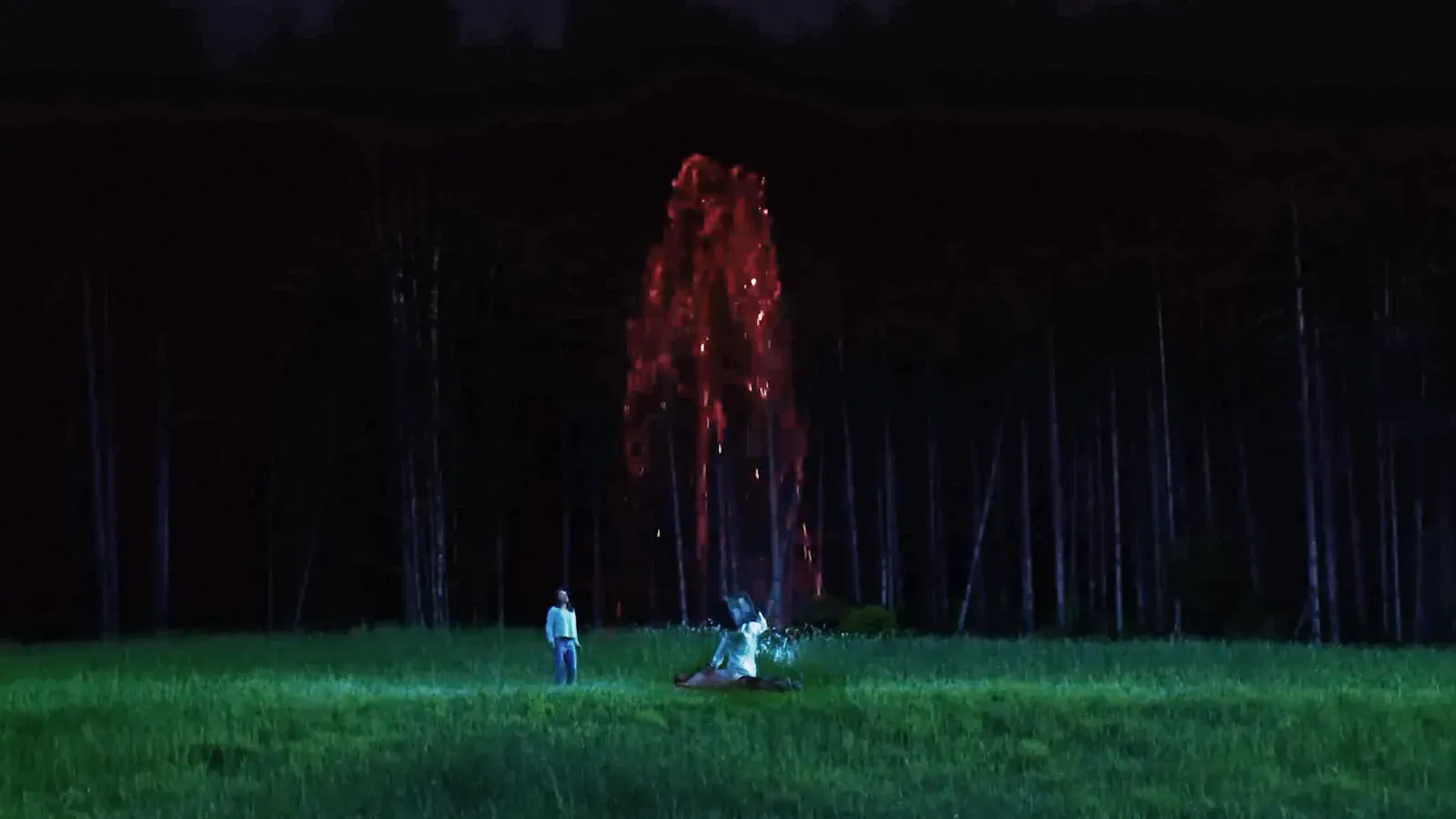
To be sexual, as a transfeminine person, is to be seen as violent, as monstrous, as predatory. It is to be seen as a man — because, really, aren’t man and violent the same thing. Isn’t that what you mean when you say dick. When the Hannah Einbinder character shuts down, her fears aren’t just about staying in her body, or experiencing her body’s wrongness; they’re about being a misogynist. She can’t so much as talk about sex without worrying that she’s “Me-Too-ing” anyone who hears her.
To let that violent, monstrous, boy-who-thinks-he’s-a-girl into the room with you — to admit that, yes, you really are experiencing desire as a trans(feminine) person, that you are doing something you’ve only ever seen depicted as perverted and horrific; that the monster at the bottom of the lake is you, and it feels good to let that spear sink into another person’s flesh, to hear them scream and to see the splatter — is another kind of death, another self-obliteration.
Yet you are never only the monster. You are also always the girl. We teach women — not just trans women, but all women — that sexual desire is a male trait, that actively pursuing or wanting sex makes them masculine. Women can only ever fall victim to men’s desire, and the good ones manage to ward it off entirely; that’s why the Final Girl is always a virgin. It’s important to note that neither Gillian Anderson nor Hannah Einbinder are, or want to be, Final; their mutual fantasy is to be the slut, the bad girl, the one who lets herself get caught. They don’t want to escape the killer. They want to get penetrated in the end.
The desire is to succumb to desire — a desire which the entire culture might tell them is “masculine,” but which is undeniably their own. It’s a lesbian relationship; there are no men in that room to do the desiring, but the culture still teaches women to project their desire outside themselves, to attribute it to some other, male source. They have to see themselves through two lenses, simultaneously: The killer, who is allowed to want this, and the girl, who is allowed to get it. The “masculine” self, who pursues pleasure, and the “feminine” self, who experiences the pleasure being pursued.
When trans women do this, it’s called autogynephilia. When cis women do it, it’s just called sex. “Men look at women and women watch themselves being looked at. This determines not only most relations between men and women but also the relation of women to themselves. The surveyor of woman in herself is male: the surveyed is female. Thus she turns herself into an object of vision: a sight,” says John Berger, and you will note that the word trans appears nowhere in that passage, or in the many, many passages by Laura Mulvey and Carol Clover that say basically the same thing.
All women are taught to do it, this splitting; we just pathologize trans women because they’re trans. All men, not just trans ones, are taught that somebody has to be the woman, and that failing to be sufficiently aggressive or dominant sexually makes you the woman; all men are taught that having sex with other men makes you the woman, but that when two men have sex, one of them is especially the woman, and therefore especially bad. Everyone — men as well as women — learns that being a woman is terrible and humiliating and makes you bad and dirty and subhuman, but that someone always has to be one, even when there are no women in the room.
12) What I like about Camp Miasma, what I respect about it, is that it's less interested in telling us what queerness has to look like than it is in pushing queer people to work out desire and intimacy on their own terms. It posits that the ultimate in Queer Sexual Liberation is not working at a dildo store or memorizing a monologue about butt stuff or giving your pronouns at the top of a conversation or engaging in compulsory polyamory with a guy named Thor. The ultimate Liberation is trusting even one other person enough to tell them what’s actually going on with you, and even the most outwardly Liberated queer people sometimes cannot do it. How could we? What does every queer person learn as the first and most important truth about our sexuality? If I let other people know who I am, they will kill me. If I tell you what I want, I am going to die.
If I never tell you, I will never get what I want, and that is its own drawn-out form of dying. What did I do? I went back on testosterone; I am on testosterone, now, as I write this, though it’s a lower dose, and my body is still catching up. I booked an in-person appointment at the Planned Parenthood, and I looked an actual, physical stranger in the face and said “I WAS EXPERIENCING PAIN DURING SEX AND WOULD LIKE TOPICAL ESTROGEN,” and then they asked me if I would like a physical exam, and I manfully squeaked “… I??? Don’t think???? That’s a good??? Idea???? Right now????? Thank you????” because there is only so much personal growth a man can experience in a single afternoon.
I did some psychological reckoning, and I realized that “you’re only a Real Man if you top” — a sexual philosophy espoused in, like, 3,000-year-old Viking texts about who gets to rape the slaves after a battle — is probably not a cutting-edge feminist statement, all things told, and it’s not a dictum I particularly want to adhere to. I realized that I had set up an inner dichotomy that said I could either be a man, or I could be with men, and that this was wildly homophobic. I realized that I had to start calling myself gay, not “gay” as an ironic umbrella term, not “gay” with an asterisk, as in “given the infinite vagaries of gender as they unfold in my ineffable and complex being, I suppose you could call me a ‘man’ who is attracted to ‘men,’ or ‘gay’ if you want to oversimplify,” definitely not “queer” as in “I’m not answering this question,” but gay, as in, I’m a man, and I have sex with a man, and that’s what some men do.
There is no-one outside me doing the desiring. There’s the person who wants it and the person it happens to, and when you are very lucky, those two selves actually do connect. It takes some work to connect them. Maybe that work is different for everybody. Maybe.
13) Or maybe the real secret, the terror hidden within the darkness of Camp Miasma, is that, though the places we start from differ, the destination is always the same.
Teenage Sex & Death at Camp Miasma is in theaters now.
I also write comic books, not that any of them will be well-served by this little disclosure.
Clayface: Celebrity Dirt #2 is out now at comic shops and digital platforms. Issue #3 is coming on September 9. My short story "The Model" is in EC's Catacomb of Torment #14; you can check out a preview here.
In the meantime, you can pick up Be Not Afraid in collected edition; DILF in both book and smell form; and put in a pre-order for the collected edition of Dead Teenagers, due out October 6.