Blood and Guts in High School: On Dead Teenagers
The first time I knew for certain that I was going to die, I was watching Final Destination. I was eighteen years old, and I had gone with a group of friends to the mall to watch it on opening night, a decision I do not regret: It was the last and grandest of the big ‘90s slashers, written by two of the best X-Files writers (in fact, it started life as an X-Files script, which you can sense by the presence of the two FBI agents who are just sort of… there) and remains, to this day, an absolute thrill.
But the point of its story — that death is going to get you, no matter what; that if you get off the doomed plane, you’ll die in the shower, and if you run from the house fire, you’ll fall on a knife — is something that teenagers, famously, do not realize to be true about themselves. At the beginning of your life, with the risk-assessment parts of your brain still developing, death feels more like an interesting hypothetical than a certainty. At least half of all horror movies are written about and marketed to teenagers, because they can watch people exactly like them die in horrible ways and not get depressed.
I was eighteen years old, watching Final Destination — on the precise boundary that separates “child” from “adult” in this culture, two months away from high school graduation and five months away from college — and when I entered that theater, I didn’t believe my own death was inevitable, and when I left it, I knew. I wasn’t depressed by the realization. I wasn’t even scared, exactly. A door had opened in my mind, and on the other side, there was the knowledge that every life — including my own — was finite, and would have an ending.
The opening of that door, the willingness to walk through it, is adulthood. I didn’t even realize my adulthood had started, the night it happened; I was buzzing and laughing and talking to my friends, the whole way out of the mall. Because here’s the other thing: When you realize you’re going to die, you realize you’re not dead yet. And getting to be alive is so much fun.
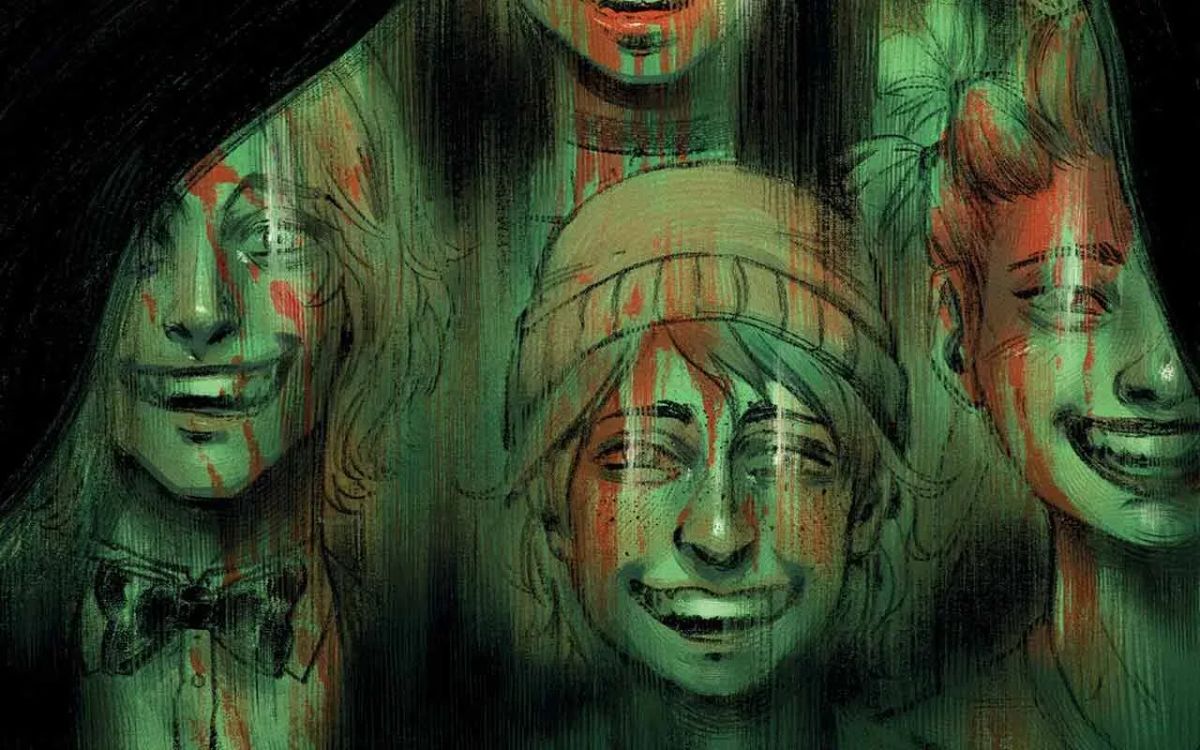
Dead Teenagers — the comic we are gathered here to talk about today, whose final order cut-off is this Monday — is a slasher. It is my theory that everyone who truly loves horror has a slasher somewhere in them, and that it’s less a genre than a poetic form, like a sonnet: The structure is inherited, but what you fill it with is all you.
This is my slasher, and it’s about five friends who go to the prom and die horribly, again and again, because death is always going to get you. Beyond that, I almost can’t talk about it: More than most things I’ve written, Dead Teenagers has a Plot that can be Spoiled. I’ve written another piece, sort of a companion to this one, that I’ll post after the final issue, when I can tell you what I was really thinking.
What I can tell you right now is that Dead Teenagers is the first thing I’ve written that really embraces joy as an option. It’s the first comic I’ve written that intends to be fun: There are jokes. There are ridiculous monsters. There are bright colors. All of that is intentional, and all of that part of the teen slasher genre — this is the goofiest and brightest and silliest kind of horror, and that bright tone does not necessarily limit its gruesome possibilities in re: how these stupid-ass teenagers are going to die.
Slashers have room for both horror and joy, because when death is close, life is close — it’s why the genre is so notoriously horny — and we feel all the good parts of being alive even more intensely. I suspect that this, even more than teen callousness, is why slashers are so often about young people. The teen years are when life feels most boundless and full of possibility — even the possibility that Death itself can be beaten.
I think we all understand futility these days. Pushing and pushing against a wall that won’t yield, every different action leading to the same result, the mounting feeling that none of our choices matter: What is Trump 2.0, if not a cruel time loop?
What we too often forget is that if we’re still here to push, we’re not dead yet. We’re not even beaten. In the past month or so, the news coming out of Minnesota has been genuinely horrific, and has included the deaths of two civilians who were trying to do the right thing by their neighbors – but it has also demonstrated, for me at least, that people will keep showing up for their neighbors, even under deadly conditions. The horrors are very real, but the decency in people is too, and it's that second part that's actually surprising. Watching footage of ordinary people blocking in an ICE truck with their bodies is the first time since November 2024 I've actually felt hope.
So as weird as it is to be talking about joy right now, that's what I can tell you: The babies and friendships and jokes and good meals and hookups and silly comic books all still matter, not despite, but because of the bleakness that surrounds them.
Every character in Dead Teenagers copes with the inevitability of death in their own way. Brandy gives herself over to hedonism, living every second like it might be her last. J.T. collapses into cynicism, figuring that nothing she does will make a difference, so there’s no use trying. Ryder tries to find some heroic action to undertake, something that will give his death — and therefore his life — meaning.
For all of them, though, the way they die changes the way they live. Death isn’t just an inevitability or a dark unknown; it’s the form they’re given to work with, the structure into which they can put their own poetry. It’s the reason to be everything they are.
I will be real with you: This is a book about queer teens and/or young women coming into their own in a world built to annihilate them. It’s a comedy, by some standards, but writing a comedy called Dead Teenagers the year Nex Benedict died was not an accident. Releasing it when the Epstein files are all over the news also doesn’t feel like an accident. The darkness of the world is real, and death is not the only way it gets you.
But watching the dead teenagers pop up and resume their fight to survive, over and over and over, no matter what life and/or the script throws at them — watching them refuse to accept the inevitability of failure or doom, no matter how clear the writing on the wall might be — is a joyful thing. These kids matter. Who they are matters. Who they could grow up to be matters. Their victories against that ever-annihilating world matter — not despite the inevitability of pain and loss, but because of them. One must imagine Sisyphus slashing.
So that’s Dead Teenagers, and that’s all I got. Over the next few months, I’ll be celebrating its release by writing up some of the many silly slashers that inspired and informed it, and I’ll be back, when the series concludes, to tell you more about what I think it means. Go put it on your pull list. Read it. It’s not going to fix everything, but it’s fun, and having fun means the dark hasn’t got you yet.
Dead Teenagers #1 is out March 18, 2026. Its final order cut-off is this Monday, February 23. Put it on your pull list! If you need incentives, here's an extended preview and an interview with me and artist Caitlin Yarsky over at Nerds Rule the World.
Two days later, on Wednesday, February 25, we'll release the sixth and final issue of Be Not Afraid. I'm so, so proud of this series and how it turned out; thank you for making it with us all the way to the end.
DILF: Did I Leave Feminism, my third book of non-fiction, is available wherever books are sold, via Bookshop.org, and (in smell form) at Black Phoenix Alchemy Lab.
Finally: It turns out I am not the sort of author who can launch projects while completely avoiding social media, so I'm trying to be more active these days. I'm also trying to use the sites I actually enjoy, like Goodreads and Letterboxd, rather than heading straight back to TwXtter to get my brain cooked. Why don't you follow me there, starting with this Letterboxd list of inspirations for Dead Teenagers?