The End of Dead Teenagers
Breaking free of the loop, and the guys who made it.
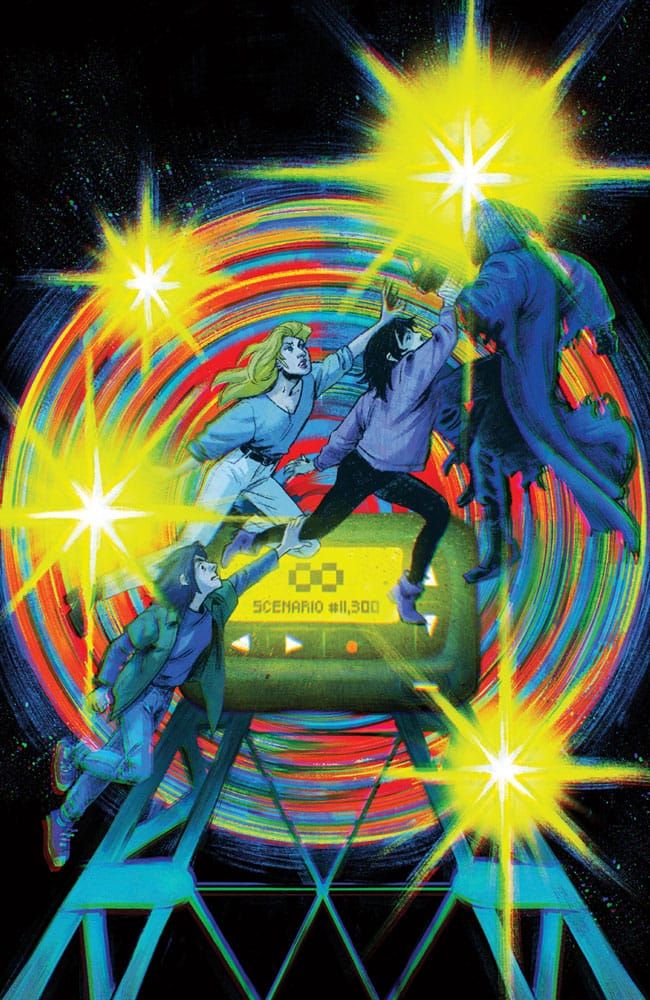
At last, at last: The final issue of Dead Teenagers is out today. This has been such a delightful time – out of everything I've written, this was most purely just done with the goal of having fun and goofing off, and I'm so lucky that other people wanted to read it.
I promised I would write you an essay about What It All Means after the final issue, and here it is.
Before that, though, news: DC Pride: The Heart Wants and its editors Andrea Shea and Jillian Grant won the Eisner for Best Anthology, meaning that I am now responsible for exactly 1/41st of an Eisner Award. It was an honor to be a tiny part of such a fucking amazing book, so go read it and revel in the genius of the team, in particular the people who had to work with me: editors Ash Padilla and Andrea Shea, writers Josh Trujillo and Tim Sheridan, and artists Alex Moore and A.L. Kaplan.
You can catch a full list of the winners here. All of them should be very proud.
When I was in middle school, my favorite comic was Generation X. It was the teen-branded X-Men comic, still (when I read it) under the auspices of Scott Lobdell and Chris Bachalo, and though it was titled to ensure generational relevance in the gritty 1990s, I am confident that everyone who actually read the thing was a millennial, because it was one hundred percent for children.
It wasn’t the kind of comic that would appeal to an older audience, or even a teenage one. It wasn’t anything like the underground comix you could find listed in Factsheet Five or the mainstream-but-literary comics being published by Vertigo; it ganked Chris Bachalo from one of those scenes, and Jim Mahfood from the other, but it managed to do so without obtaining any subcultural cred. So it’s a silly superhero comic, you’re saying, but it was barely even that: Most of it was just teenagers, like, hanging out, playing board games, doing Banter that seemed witty to a twelve-year-old, and nurturing crushes that were always somehow unrequited in a way that required them to be spun out over years and years and dozens and dozens of issues.
All of this, especially the Banter, was done much better on Buffy the Vampire Slayer, which premiered two years later and soon took over whatever cultural niche Generation X might have theoretically carved out. (By the time I was in college, Scott Lobdell was writing the Buffy comics and Joss Whedon was writing X-Men.) By the late 1990s, I had stopped reading Generation X, and so had pretty much everyone else. The series was canceled, and the imaginary teens I grew up with started dying.
It was a slaughterhouse. Synch, the All-American everyboy, sacrificed himself to save the school from a bomb blast. Chamber was depowered, which left him with a gaping hole in his chest where his heart and lungs should be. The longest-running and seemingly safest character, Jubilee, got turned into a vampire; my favorite, Angelo Espinosa, was crucified by a hate group, died off-page, was buried, and had his corpse exhumed and rejected by mutantphobic cemetery ownership, all of which was somehow less insulting than the fact that his former teammates Husk and Jubilee engraved the wrong name on his tombstone. (“Torres,” after one of his girlfriends. I tried to tell myself he’d just gotten married really, really young.)
Characters in comics die all the time, and they also come back to life all the time — by the 2020s, Jonathan Hickman had managed to resurrect the entire team — but this was my first time watching it happen, and it was a grim way to enter adulthood. I had bonded with these characters, projected my own adolescence onto them, only to watch them get unceremoniously mulched the moment they left high school. As time went on and the world got worse, Generation X came to seem like a prophecy about how its millennial audience’s lives would play out: They were supposed to be the next big thing and the face of evolution and the key to Good’s triumph over Evil, and then 9/11 happened and all their lives went immediately to shit.
It was a big letdown, adulthood. It was the death of all your imaginary teenagers, and all the futures you had imagined. That was the first time the ‘90s died for me. The next death happened later, and it was much, much worse.
I was in my thirties when I heard the other stories about Scott Lobdell: That he had a history of approaching emerging comics creators, especially young women. That he would promise to introduce them to his editors, or hook them up with new work. That the price of getting your work promoted by Scott Lobdell was stuff like this: