Reading Rainbow
On problematic feminists and what queer people are allowed to read.

Angelic horror comic Be Not Afraid makes its triumphant return to comic stores January 28, 2026. You can get the full preview over here, via Boom!
Dead Teenagers, a slasher about nostalgia and the never-ending horror of high school, will be out in March of 2026 from Oni Press, with art by Caitlin Yarsky. You can see a few pages here.
Finally: DILF: Did I Leave Feminism, my third book of non-fiction, is available wherever books are sold, via Bookshop.org, and (in smell form) at Black Phoenix Alchemy Lab.
A few weeks ago, my daughter came into my office with a confession. “I did something you’re going to be mad about,” is what she said, and she said it with real fear. I steadied myself to learn what horrifying crime against humanity an eight-year-old might be capable of.
“The Harry Potter books were free on Kindle,” she told me, “so I downloaded them, and I started reading one.”
Until now, I’ve managed to keep my kid away from Harry Potter. I knew it was a temporary arrangement. She loves fantasy. Her favorite author is Rick Riordan, whose Percy Jackson universe is a blatant Harry Potter rip-off, albeit with better politics. Her peers watch Harry Potter movies or read the books, and sooner or later, she was going to wonder what she was missing. I told her that the author was hateful, and that she wanted to make life worse for trans people. But I knew, even while I was saying it, that I always found a way to watch or read everything my parents told me not to watch or read.
So I had a choice: Get predictably mad, and make the books more tempting, or sit back and let my kid get TERFed.
“A lot of good people have read those books,” is what I said. “I read those books, before I knew how she felt about trans people. I think it makes sense for you to be curious. But you should also know that every time you give her money, she uses that money to hurt trans people, and to pass laws that make life harder for families like ours.”
“This was free,” she said.
“I don’t mind free,” I said. “But you should know in advance that I won’t buy you Harry Potter toys or games or movie tickets, and I won’t pay for the books in a store, because that money is used to do bad things.”
“Dad says some of her writing is weird,” my kid said. “Like, who she likes and who she doesn’t like.”
“That’s true,” I said. “Now that I know how hateful her beliefs are, some of the writing stands out to me as having a bad message. But I didn’t really see it, the first time I read it, and it’s okay if you didn’t see it, either. I know you’re a good person and that you would never willingly hurt anyone.”
She nodded very vigorously at that last part.
“I would rather have you read the books, and trust me enough to talk about them, then have you read them and keep it a secret,” is what I said.
I’m telling you this for a purpose. This kind of engagement — read it, but with a critical eye, and be aware of the harm it’s caused — is my standard practice for dealing with problematic material. It’s simple enough that I would trust a reasonably bright eight-year-old to do it. I think it makes sense to start here, with what I would tell an eight-year-old, when we’re talking about what queers or feminists are “allowed” to read.
WORD Bookstore, in Brooklyn, is selective in what they stock. They don’t put things on the shelves unless they believe in them. The upside is that I’ve never regretted purchasing a book there. The downside is that I don’t make the cut: The “feminism” section is one shelf long, and I’ve never seen one of my own books there.
I will tell you what I did see, though, on my most recent visit, set right out on the display tables that mean someone has decided it’s a book to notice: Right Wing Women, by Andrea Dworkin, recently re-issued and with a new introduction by Moira Donegan.
Seeing Dworkin at WORD was something I would never have predicted ten years ago. It’s probably a reaction to Trump, like everything else: Third-wave feminism, to be somewhat reductive, placed a huge emphasis on joy and pleasure. It was highly engaged with pop culture. It was highly sex-positive. Sex worker feminism, trans feminism, queer feminism did not start with the third wave — Sylvia Rivera was a sex work-inclusive trans feminist, if anyone was — but they were all given a huge boost by it.
At its best, this joy was intersectional (another third-wave concept) and radical. It told women that their orgasms mattered, that their art mattered, that fandom and fun and femininity mattered, that they mattered; it practiced pleasure as a means of building a better world. At worst, it was consumerist, shallow, and easily dismissed as apolitical: If feminism is just whatever Beyonce or Taylor Swift are doing, what does that have to do with improving the lives of working-class women and gender-marginalized people? If feminist just means buying a particular album or watching a particular movie or using a particular body-positive brand of soap, is it politics at all, or is it just shopping? Learning how to use a vibrator might very well change your life, but how does it change the world, exactly?
As early as 2016, Jessa Crispin’s Why I Am Not A Feminist argued that third-wave feminism was a wash, and that it had lost touch with its radical roots in the second wave. I found Crispin’s argument annoying in the moment, but after Trump won, it became more and more common. Young women who turned to feminism in the Trump era were not looking for optimism, because their conditions could not sustain it; they were focused on pain, on the loss of bodily autonomy, on reproductive and sexual and state violence in an increasingly fascist patriarchy, and they turned to feminism to validate and inform those concerns.
Second-wave feminism, including some previously despised radfems, simply felt like a better fit for the moment, and feminist publishing followed suit. Amia Srinivasan’s The Right To Sex, a second-wave text in all but its publication year, came out during the first Trump term. Andrea Long Chu’s Females, an extended riff on Valerie Solanas’ SCUM Manifesto, did too. Keeanga Yamahatta-Taylor released a combined reprint and oral history of the Combahee River Collective statement in 2017. Dworkin references began popping up on The Cut, and Donegan, who has devoted much of her career to rehabilitating Dworkin’s reputation, became a popular feminist commentator; she currently has 95.1K followers on Bluesky, and though she’s yet to publish her own book, Dworkin’s books sell in part because her name is on them.
The second-wave turn in popular feminism was — thankfully — queerer and less white than its predecessors. Some, like Donegan, do seem intent on recreating second-wave feminism's worst errors, but she's an outlier. Hugh Ryan’s The Women’s House of Detention contains a long and relatively sympathetic section on Dworkin’s experiences in the titular institution. Srinivasan doggedly cites trans women and argues for the decriminalization of sex work. Sophie Lewis, avowed nemesis of both Donegan and Dworkin, leans heavily on Shulamith Firestone’s work in her books on family abolition. Talia Bhatt’s Trans/Rad/Fem was a major grassroots success just last year; despite being self-published, it was the number one bestseller in “Feminist Theory” on Amazon for quite some time, and was commended by transfeminism’s founding theorist, Sandy Stone.
These writers are often left in an awkward position with regard to their predecessors’ — let’s say — more dated work. Sophie Lewis duly mentions Firestone’s racism and obliviousness to queer people, but does not spend much time engaging it. (To be fair, I don't either.) Andrea Long Chu argues, in Females, that “the question of whether Valerie Solanas was a TERF is probably unanswerable,” and cites her sometimes-positive relationship with Candy Darling.
With respect to Chu — who could slice me into carrot sticks with one well-aimed sentence — I think it’s pretty answerable, actually. Solanas did once say that Candy Darling was a “perfect victim of male suppression” (“gay men are okay but they’ve got to be taught to be more respectful of women’s rights,” she added) but later in their relationship, as per biographer Breanne Fahs, she decided that Darling “made fun of women for the benefit of gay men” and had therefore committed “war crimes.” Her depictions of trans women in her play, Up Your Ass, are unremittingly negative. So at best, Solanas saw Darling as a “gay man” who had the good sense to emulate women, and at worst, she saw her the way TERFs do: As a mockery of a woman, someone whose mere existence constituted misogynistic violence.
I also happen to love Females. I think it’s a great book. It irritates me, because Chu is purposefully trying to irritate cringe millennial feminists, and I am one, but I like the provocation. What’s thrilling about it is how thoroughly Chu manages to appropriate Solanas’s work — she takes the SCUM Manifesto away from everyone, including the actual, historical person who wrote it. What Solanas actually meant is not the point any more; what matters is what Chu can make of her, the new meaning she creates in and through and sometimes despite of the work. It’s like Johnny Cash covering “Hurt,” or Jimi Hendrix playing “All Along the Watchtower;” the cover outdoes the original. The song becomes her song.
Not everyone can do that. I couldn’t. But it is inspiring, and it adds another rule to the read, interrogate, contextualize list: Take what you need. Change what you don’t. Feminist theory and gender theory have always been about trans people, even when we weren’t allowed to participate in their creation – especially when we weren’t allowed to participate in their creation. When we do choose to work within those traditions, we are entitled to take, use, or tweak any source material we like, even (or especially) if the original author wouldn’t like it.
Which is all to say: The process of revisiting and rewriting formerly unfashionable figures of the second wave has been going on for quite some time, and several high-profile trans writers have done it. Yet, when my most recent book came out, I still had to grit my teeth and prepare for the inevitable scuffle over Andrea Dworkin.
I don’t actually want to talk about Dworkin any more. In a book that cites (to my own incomplete recollection) Cameron Awkward-Rich, Gloria Anzaldua, the many unnamed women of the Haudenosaunee Confederacy vis-a-vis their strong influence on first-wave feminism, Susan Stryker, Judith Butler, Julia Serano, Jane Ward, Monique Wittig, Florence Ashley, Shulamith Firestone, Dorothy Dinnerstein, Silvia Federici, bell hooks, Patricia Hill-Collins, Sandy Stone, Beth Elliott, Andrea Dworkin, John Stoltenberg, Judith Herman, Lee Edelman, Pauli Murray, and then loops back around to Jose Esteban Munoz and Judith Butler again via Buddhist peace activist Thich Nhat Hanh, it’s exhausting to spend 98% of my time talking about one of those names. The feminist I've mentioned most often in interviews, as an influence on the book and on my thinking, is hooks. It seems depressing, and symptomatic, that people are less interested in asking about her.
I should also stress that the scuffle that got kicked up around that reference was small, and mostly from people who hadn’t read the book. People who have read it overwhelmingly have a more positive reaction, and that’s because the book is not, actually, an uncritical valorization of Andrea Dworkin. I know this, because one of my editor’s initial notes was that the criticism of Dworkin seemed overly harsh, and I argued for its continued inclusion.
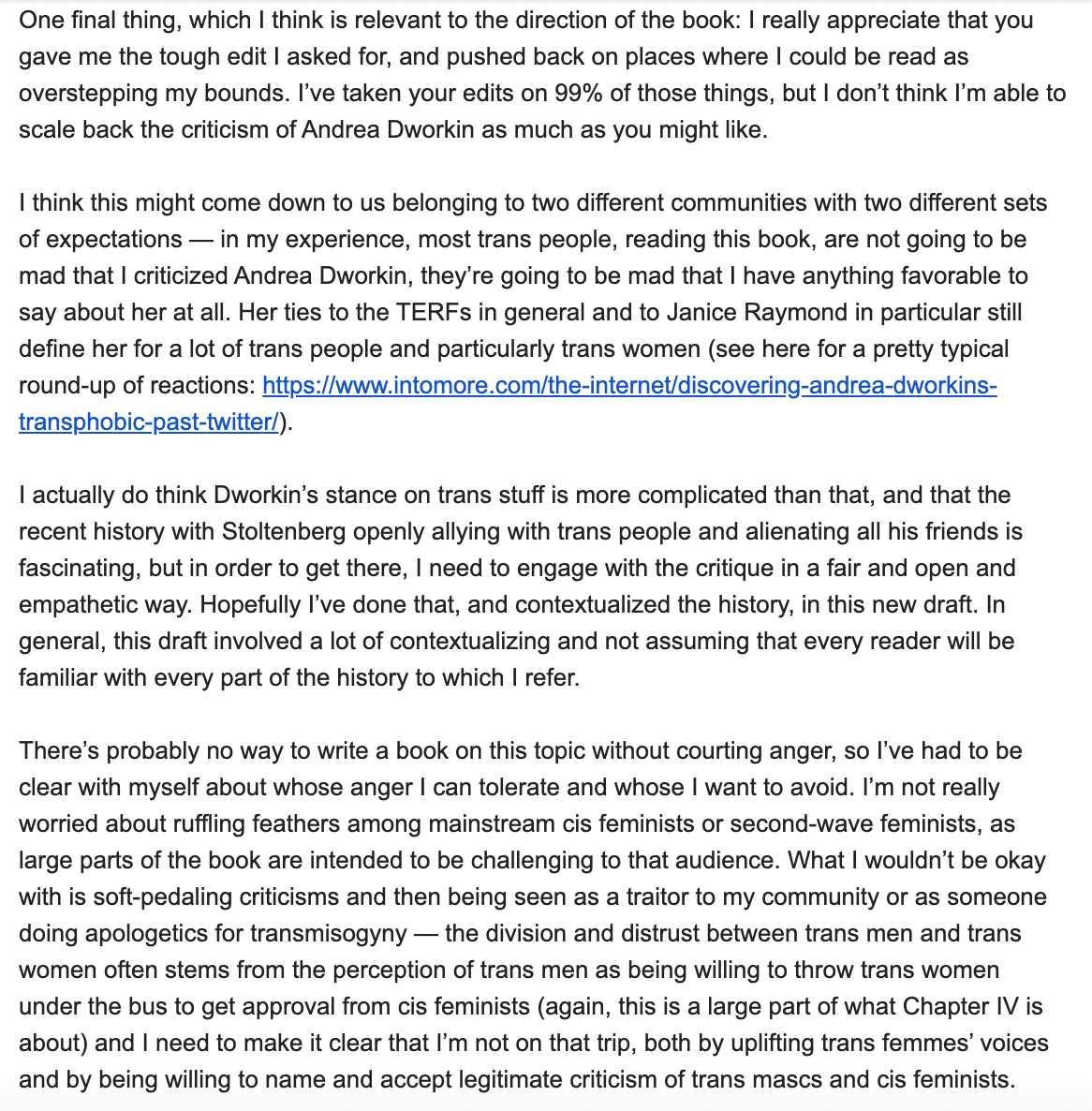
Now: Precisely because an increasing number of readers will be primed to see any criticism of Dworkin as misogynistic or unfair — the hagiography coming from her side is not subtle — it’s important for that criticism to be well-substantiated, fact-checked, and nuanced. I also think good criticism, generally, requires nuance and empathy for its subjects. I didn't really like the Ari Aster movie Eddington, but in order to say that, I felt it was important to understand what the movie was trying to do, and to acknowledge where it succeeded. If I owe that much patience and consideration to a movie, then I owe much more when it comes to ideas that are explicitly intended to change the world.
I may not have criticized Dworkin in the exact same way others would have. But the criticism does exist.
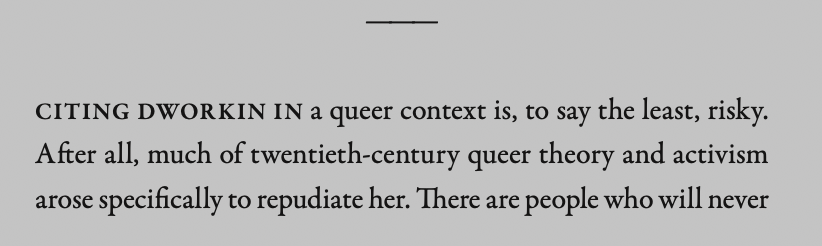
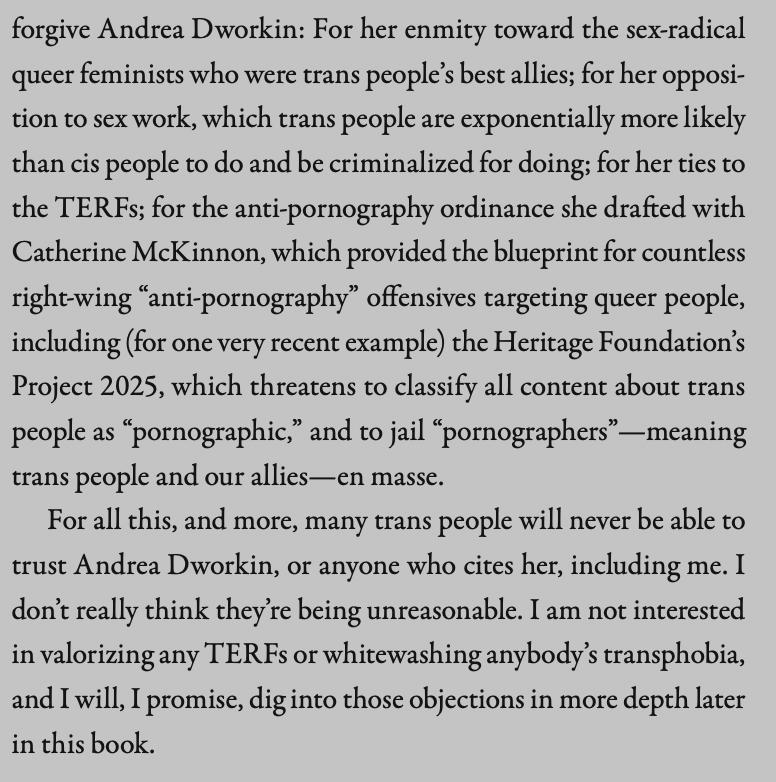
Sex work also became a flashpoint — not unreasonably, given Dworkin’s stance on the matter, but in a way that seemed remarkably incurious about what my stance is.
I’ll keep my thoughts on sex work brief; I’ve done it, albeit in a legal form that involved low physical risk, and even in that low-risk form, I did not have a good time. I came of age in the 2000s, when sex-positive feminists typically argued that sex work was “empowering,” in order to push back on the second-wave argument that it was inherently exploitative. I didn’t find those arguments about “empowerment” to be true or useful, but I also abhorred the second-wave tendency to talk over sex workers, and to accuse those who disagreed with them of being brainwashed shills for Big Sex. I stayed in the closet for a long time, not because I was ashamed, but because there wasn’t a lane for me to occupy in that discussion. I couldn’t tell the truth without being weaponized, so I didn’t talk.
I came out a few years ago because of a welcome shift in sex work activism, which has increasingly framed sex work as labor: Sometimes exploitative, sometimes dangerous, but in line with a whole world of other exploitative and dangerous jobs. It might not be “empowering,” but you shouldn’t have to prove that your job is “empowering” in order to do it. If that were the litmus test, the vast majority of jobs would be illegal.
The way to fix what is wrong with sex work is to focus, not on the sex, but on the work, and specifically on workers' rights and safety. For instance: I incurred trauma, doing phone sex, because I literally wasn’t allowed to hang up on any of the calls. I was being monitored by my bosses the whole time, and no matter how upsetting something was, I had to let it keep happening, in ways that ultimately violated my consent. If I had a union, we could have demanded the right to refuse clients without being penalized. The job would have been safer, and easier, and ultimately more feminist, in that it recognized consent as an important factor of the work.
I’m no authority, and there are better writers you can read on this topic, but I do not think my politics can be construed as anti-sex-worker by any stretch of the imagination. Nor, very obviously, are they anti-trans.
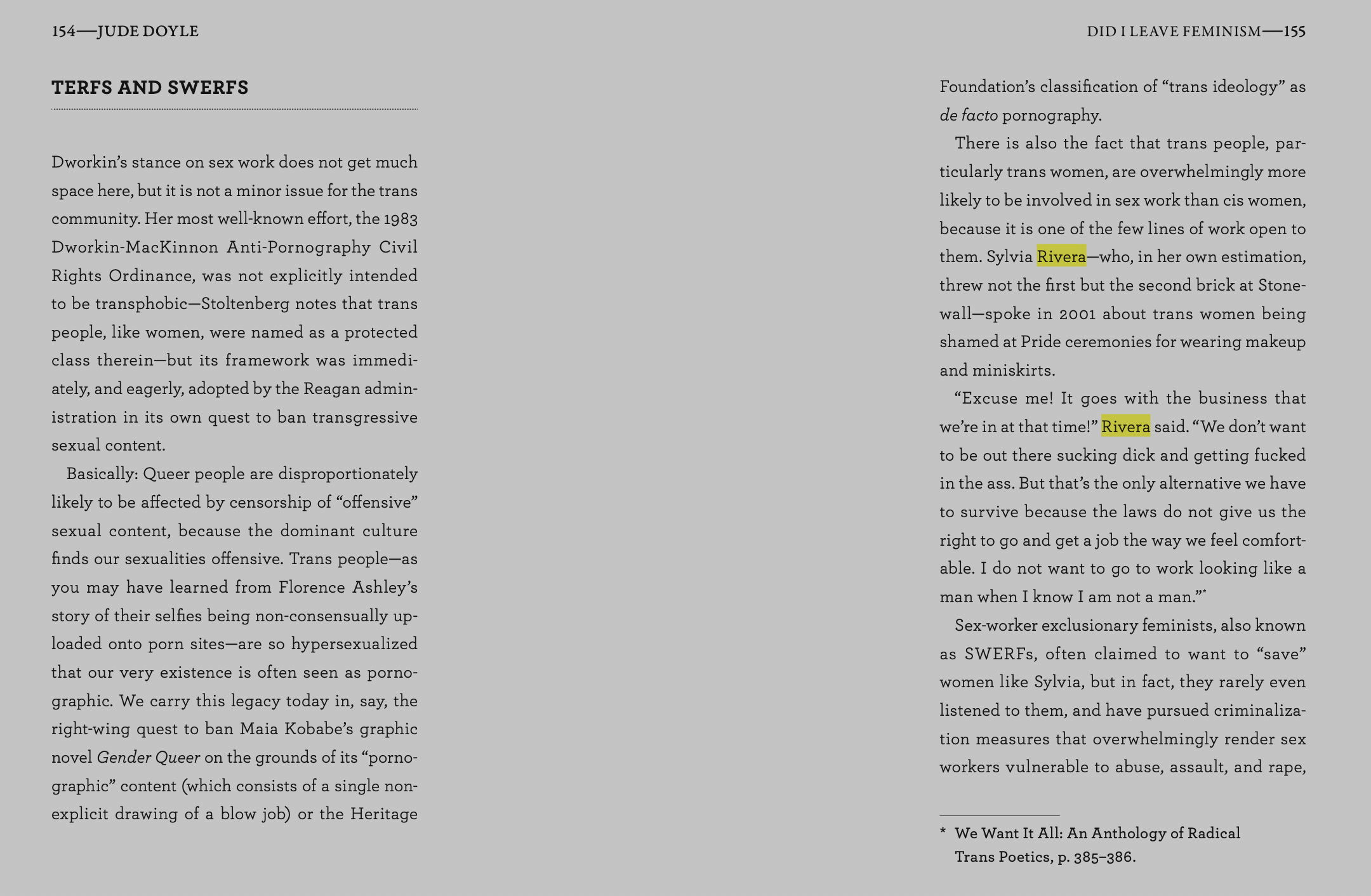
That said, I’ve never hidden the fact that Dworkin fascinates me as a historical figure. On the one hand, TERFs have long proclaimed her as one of their holiest leaders, and will insist to their last breath that she agreed with them. On the other hand, the two people who worked with her most closely, in her lifetime — Catharine MacKinnon and her husband, John Stoltenberg — are decisively not TERFs, and they insist Dworkin wasn’t either.
The actual record seems to show a shift from pro- to anti-trans views over the course of her lifetime: In her first book, she argued that the state should provide gender-affirming care to transsexuals; in her last book, she thanks Julie Bindel in the acknowledgments and makes bigoted cracks about Patrick Califia’s transition. Stoltenberg loves his wife, and insists she wasn't a TERF, and I am in no position to claim I know her better than he does – but, at bare minimum, she seems to have believed that trans inclusion was something on which reasonable people could disagree. So Dworkin is a useful case study because she mirrors the trajectory of radical feminism, which was surprisingly trans-inclusive until a group of high-profile academic feminists made a power grab to push the trans women out.
Her work is also interesting — to me, anyway — because of a schism in radical feminism surrounding the question of “biology.” One strand of radical feminist theory argues that everything about the patriarchal gender binary is socially constructed, up to and including its basis in (so-called) “biology;” that human sexual and reproductive anatomy does not fall into a neat binary, and that the way we interpret the body is ultimately political. Dworkin argued this for most of her life, and Stoltenberg still argues it today. The other strand insists that “biological sex” is the material basis of all oppression, and that feminists should restrict themselves to protecting “women’s” “sex-based rights.”
Follow one strand to its logical conclusion, and you have to become a transfeminist; follow the other, and you have to become a TERF. So Dworkin, despite her eventual drift toward the TERF camp, also helped to create feminist theory that disproves TERFery; that theory, prefiguring the work of Judith Butler, holds that "sex-based rights" or "biological gender" are a political fiction, created by the patriarchy to justify its own existence. Transphobic feminism contains the seeds of its own destruction; at the core of its sacred texts, there is an admission that the movement is built on a lie.
That fascinates me. Why wouldn't it? Yet that's an argument you can only make if you’ve read Dworkin, the same way you can only criticize my book if you’ve read my book. This is one of the costs of disappearing history: If a text is so “problematic” that you are actually forbidden to look at it, you have little or no chance of knowing what it gets wrong.
This is not some far-away, theoretical debate. One of the people who was angriest about all this had, in fact, read DILF. In fact, they were in it. I'm not naming them or using an identifying pronoun – I will if they ask me to, but more than one trans person familiar with the situation worried that it would place a target on their back. As far as I can figure, they felt blindsided by my citation of Dworkin and interview with Stoltenberg. They argued that, by “platforming” their work, I was paving the way for TERFs and SWERFs to infiltrate the community — once people started reading Dworkin, the process of radicalization would be inevitable – and that by interviewing them, I'd inadvertently enlisted them in whitewashing figures they despised.
It was a tough conversation, and it left me rattled; not angry, but bewildered, and sad, and upset with myself that I had failed to communicate. As a professional, I stand by the ethics of the interview. I told this source up front that I was talking to them because their experiences with feminism had been more negative than mine, and that I wanted to represent multiple points of view; there was no reasonable expectation that they would agree with everyone else in the book, or with me, nor did I make any claims to that effect. I showed them the section in which their quotes appeared, multiple times, so that they could make corrections and ask for sensitive information to be redacted; they approved what I sent. They didn’t ask who else I was interviewing, nor did they tell me that granting the interview was conditional on approving my other sources or agreeing with my conclusions. To be clear: I would not have agreed to those conditions if they had set them. If your sources start deciding what you’re allowed to say, or who you’re allowed to talk to, they essentially become uncredited co-writers. It’s unethical for me to promise that to anyone, no matter who they are.
I can tell you that, but the truth is, I like this person, and I feel pretty awful about having offended them. Their opinion matters to me. So does their well-being. On the professional level, I can stand by my choices, but on a personal level, someone I respect is angry, and I feel sick that I made them angry, and it's really sad.
The truth, though, is that I knew people would be angry; I just didn't know my colleague would be one of them. I made the choices I made because I thought they were worth any anger they might inspire. So if I can move past my emotions and onto my choices, I would tell you that, as a feminist writer, I have every right to engage with one of the major developments in the movement over the past ten years. Moreover, my responsibility to engage is more pressing, not less so, if that development has a potential to be harmful.
The most obvious problem with "deplatforming" Dworkin is that it hasn’t worked. We third-wavers pushed this theory under the rug, rendered it impermissible and untouchable, and the next generation has dragged it right back out again, reprinted it, and put it on the display table in the bookstore, this time repackaged as the hardcore, edgy feminism third-wavers don’t want you to read. We’re Mom and Dad, trying to keep the Harry Potter books or the heavy metal records or the violent video games out of their hands, and they, like all young people everywhere, insist on the right to see it and judge it for themselves.
Like all young people, they deserve that much. Treating second-wave feminism like some kind of literary smallpox blanket is insulting the intelligence of those young people — mostly, though not always, young women — who are smart enough to read something without immediately endorsing all its conclusions. The very same people who set themselves up as champions of free expression and “transgressive” literature, who insist that no amount of televised rape scenes will make you a rapist, and no amount of sexism in media will make you a sexist, and no amount of seeing trans people talk to each other online will trans the nation’s children, also seem to believe that reading a single page of Dworkin will make you a TERF or a SWERF.
Problematic figures exist in the history of every movement, and we find ways to grapple with them. I know and like leftists who derive their views on the ethical application of violence from Frantz Fanon; this would be the same Fanon who famously wrote that some women “just ask to be raped,” and who — when displeased with his wife — would hit her, sometimes in public, and say “I am avenged.” You would be hard pressed to find a more committed leftist in literary history than Jean-Paul Sartre, and yet existentialism was heavily based on the work of Heidegger, who was, in fact, an actual Nazi: "Don't you know that sometimes a man does not come up to the level of his works?" Sartre wrote, defending himself. "If we discover our own thinking in another philosopher, if we ask him for techniques and methods that can give us access to new problems, does this mean that we espouse every one of his theories?" In a dilemma that will be familiar to some readers of this newsletter, Sartre spent the second half of his life trying to reconcile his devout Communism and support for the U.S.S.R. with the knowledge that Stalin had opened concentration camps.
Is Angela Davis a misogynist because she likes Fanon? Is Andrea Long Chu a transphobe because she reads Valerie Solanas? Is every single member of the DSA personally responsible for gulags? Probably not; probably every single activist or radical who is cursed with intellectual honesty winds up facing some version of this problem. Even liberal democracy has the French Revolution on its conscience. The question is not finding "unproblematic" sources or movements, because there are none. The question is how to improve on the problematic sources and movements we have.
Young women are no less capable of doing that than the rest of us. The vast majority of young cis women who will pick up Right-Wing Women from that display table aren’t TERFs, and — given the gender politics of women in their generation — they are probably not looking to become TERFs. They’re looking for a way to cope with the often enormous amounts of sexual and gendered violence they have suffered, and seen others suffer. They are trying to find a way to survive a reality where all the nation’s elites more or less openly traffic in the rape of young girls, where rape is the structure of power and the privilege of those in power, and where sixty consecutive years of feminist activism have failed to make it stop.
Anyone in that position deserves our empathy. The truth is, Dworkin is very powerful in talking about that harm; she treats it with a seriousness and an outrage that is missing in the dominant culture. Her analysis of heteropatriarchy as structurally violent — an arrangement where sexual violence is the intended and expected outcome, not an exception or a mistake — is, in fact, very useful for understanding endemic sexual violence of the kind we are seeing now.
The idea that fighting rape culture is somehow less serious than any other political project – an idea which lingers at the far fringes of this conversation, but which is nonetheless worth naming, just to draw it into the light – is both heartless and irresponsible. Even in an otherwise privileged life, one rape is often enough to ruin that life. One rape is sometimes enough to end it. Survivors will always need a way to understand and oppose the harm that was done to them. If you harden your own queer heart to sneer at them, you cannot possibly be surprised when they look for their answers somewhere else.
But survivors also deserve the chance to get their needs met without hurting anyone. When the work they read has been used to do harm, they deserve to know that; they deserve to have guidance from people in the affected communities, explaining how to look at those texts with a critical eye, and contextualizing them in terms of the harm they’ve caused.
That is why I engage with all these problematic feminists: Not to whitewash their failures, nor to excuse them, but to give people context for what they are already reading. Even at their worst, those feminists were attempting to address real human suffering. Without input from trans people, feminists will never actually end that suffering. They will only find new ways to pass it down.
You cannot do that work while also holding that some books are simply too dangerous to be read or talked about. The idea that a book is capable of hijacking your higher brain functions and changing you into a TERF or a SWERF against your will is one I object to, especially when it is presented in the name of "fighting censorship." I do not want anyone's belonging or safety, as a feminist or as a queer, to hinge on obeying inflexible dictates about what they are "allowed" to read. It does us no good, as trans people, to subscribe to narratives of self-infantilization; for one thing, the idea that the Bad Ideas can get into your head and make you do things is the exact same story TERFs tell about "gender ideology" corrupting helpless young "girls." For another, alongside the history of people reading Dworkin on the way to becoming enemies, there is a very long history of people reading her on the way to becoming something else.
“Every single woman who pioneered the sexual revolution, every erotic-feminist-bad-girl-and-proud-of-it-stiletto-shitkicker, was once a fan of Andrea Dworkin,” says sex-positive feminist Susie Bright. “Until 1984, we all were.” Bright's fandom was apparently more intense than most: "I have tape recordings from colleges where I would go listen to Andrea lecture in rapt attention and turn my little cassette over to capture every word." Bright and Dworkin would become bitter enemies – unhinged Dworkin fans threatened Bright's life; Bright mocked Dworkin's account of a rape she suffered late in life, claiming it was proof that Dworkin had "lost her mind" – but she nonetheless credits Dworkin with sparking feminist porn studies and interest in porn as a politically meaningful art form. Even if it was a reaction to her, it could only exist because of her work.
People take what they need and change what they don’t; they read, interrogate, contextualize; in this way, history moves forward. The question is not what the books say. The question is always you, the reader; what you take, what you leave, and how you change the world.
Before hitting publish on this essay, I asked my kid if she was still reading Harry Potter. She told me she’d stopped before finishing the first book.
“It’s not a very good book,” she told me. “The names are weird.”
The names, I agreed, were one of the worst parts.
“I might finish it. But it’s not really my style,” she said. “‘Percy Jackson’ isn’t a weird name.”
She trusted me, and I trusted her, and — this time, at least — it worked. Harry Potter and the Sorcerer's Stone really isn’t a very good book, and the names really are weird, and that’s enough reason to abandon it. But she will be faced with many more choices, in her life, and many more problematic texts and authors; she will be placed, over and over, in a position where choosing the wrong thing might harm somebody, in a world that will continually work to make her complicit in its worst cruelties and abuses of power.
I cannot make those decisions for her. Even if it were physically possible, even if I could be with her every second of her life for the rest of her life, depriving her of autonomy would be wrong. It is not my job to make her choices. It is my job to give her reliable information and a working moral compass, so that she can make good choices without me. I cannot raise her to be a strong, independent person and also keep her on a leash and demand to approve everything she thinks or reads or sees or does. I cannot free her and control her at the same time.
I cannot control where young people will take feminism or queerness next, and neither can you; it's their world to save, or to ruin. But I believe they can build something beautiful, and that they deserve more trust than they are currently being given. The third wave is now older than the second wave was when we rebelled against it; Susie Bright is twelve years younger than Andrea Dworkin, but I am twenty-four years younger than Susie Bright, and I am not young. All of us are receding into history; if we are lucky, we will live to see ourselves become unnecessary, and to hear the kids laugh about how passé and embarrassing we were. They will throw away anything we've done that they can't use, which means that they will throw away most of it. But we can hope to leave behind something useful. We can be there for the next turn of the wheel.
Books are available wherever books are sold.
Happy holidays, I guess! Over at my other job: I wrote about the year of "post-woke," which failed because nobody actually wants to hang out with a bunch of bullies.