Mushroom Cloud: Matango, a.k.a. Attack of the Mushroom People (Ishiro Honda, 1963)
Subtlety is overrated.
Today's the day! Clayface: Celebrity Dirt #5, featuring the triumphant (???) return of Preston Payne and the story of how he became Basil Karlo, is on sale now at comic shops and the usual digital outlets. Pick it up, then put in a pre-order for the sixth and final issue (!!!!) before FOC on Monday, November 16.
You can also pick up Dead Teenagers in trade paperback at any self-respecting bookstore – and the digital outlets, too.
You know what's just as fun as a comic, but less of a time investment? Short stories, that's what, and here are some from me: EC Comics #4 will feature "Finishing School," about learning to be A Lady(TM), with art by the fantastic Ramon Bachs – you can catch a preview here prior to its release date on December 23.
I'm also in DC's Naughty List, a Christmas-themed villain anthology, with "Mistletoe," a story featuring Poison Ivy and Druidic ritual sacrifice, illustrated by the one and only Lisa Sterle. I've been a fan of Sterle's for ages, and the story just looks so beautiful I don't want you to miss it – it's out November 25.
This has taken a while, but lucky you, the post is finally here.
I assume, at this late date in history, that we’re all familiar with the nuclear symbolism of Godzilla. The monster — created by Ishiro Honda in 1954 — is a huge, city-flattening, radioactive menace, which arose from a country that had recently lost two cities to the huge, city-flattening, radioactive force of nuclear bombs.
To be brutally reductive, Godzilla represents the sheer, unholy force of nuclear weapons — the sense of something inescapably huge, bearing down on you and everyone you know, ripping the world apart — and this is what makes him terrifying. Every good recent Godzilla adaptation, from the 2014 American movie to 2023’s Godzilla Minus One, has leaned into the metaphor, because it works.
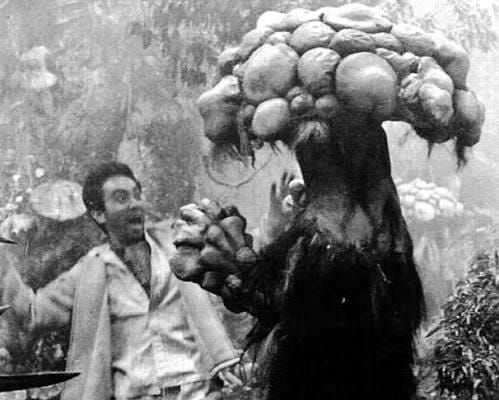
So if I were to tell you that Godzilla was neither the bleakest nor the most upsetting nuclear allegory directed by Ishiro Honda — if I were to say that he directed a pure horror movie about the subject, which got to me on a more primal level than Godzilla ever has — I hope you would be interested. And I hope you would remain interested after learning that the title of this movie has traditionally been translated as Attack of the Mushroom People.
Mushroom people do, in fact, attack, over the course of this movie — but so does environmental destruction, and starvation, and unspeakable body horror, and deep, unrelenting existential dread. What makes the nuclear attack in this movie scary is not the attack; it’s what comes after. It’s living in a world that has forever been poisoned, where both the environment and our own bodies collude to wipe us out.
So: We open on a Gilligan’s Island episode.