Mr. J. Natural: Jason X (James Isaac, 2001)
All you gotta do is to want the fun of it.

Today's the day! Dead Teenagers #3 is officially on sale at your local comic shop and the usual digital retailers. Put in a pre-order for Issue #4 when you pick it up – FOC is this Monday, 5/25.
Speaking of comics: DC Pride 2025 is nominated for a Best Anthology Eisner! I wrote one story and co-wrote another with Josh Trujillo and head writer Tim Sheridan, so I have something like 1/32nd of an Eisner nomination. Congratulations to Mr. Sheridan, editors Andrea Shea and Jillian Grant, and all the many geniuses who edited and drew and lettered and colored and wrote the thing.
Celebrate my newfound awards-adjacency by preordering Clayface: Celebrity Dirt, due out July 8.
Like a lot of the dorks you meet on the Internet, my teenage sense of humor — and culture writ large — was formed by watching MST3K, the cable-TV puppet show where comedians made fun of old B-movies. My mother found a description of it in a TV Guide when I was about eleven years old, and she thought, based on my liking science fiction and/or the Muppets, that it sounded like “your kind of thing.”
It was. It was so much my kind of thing, in fact, that I have a massive stack of VHS tapes, a childhood memory of skipping various family dinners to watch the Turkey Day marathon, a history of activism to save the show every single one of the 900 times it was on the verge of cancellation, an opening-night ticket to MST3K: The Movie (and commemorative Crow T. Robot t-shirt, on sale at Best Buy!) and the deep bitterness of someone who has met his idols, because the truth is, I had about the worst fan experience with MST3K that anyone could expect to have.
It didn’t start out bad. I used to be followed by about half of the cast on Twitter (see, again: deep, unrelenting, continuing-into-adulthood buying-the-collectibles defending-the-show-every-time-it-became-a-topic-of-discourse fandom) and, unfortunately, this somehow led to me being followed by Bill “Replacement Crow” Corbett.
I was thrilled, at first. I used to like Bill Corbett quite a lot, because he was associated with something I loved, and because I projected all the virtues of that thing— warmth, intelligence, a broad appreciation of both high and pop culture, a sense of community, an endearing punk-slash-geek DIY ethos — onto him. I had all sorts of Bill Corbett facts I could relate: He started out as a playwright! He wrote the Eddie Murphy vehicle Meet Dave! He is connected to my hometown of Columbus, Ohio, having once worked with the Thurber House, where I interned!
Another fun Bill Corbett fact is that he’s a huge jerk, which I found out during the 2016 primary, where he supported Bernie Sanders and I supported Hillary Clinton. Despite my not saying one single word to or about Bill Corbett, regarding our differences on this matter, he went all-fucking-in, until, eventually, he was posting memes about how funny it was that I was abused by my violent drunk of a father while growing up.
To be fair: When Bill Corbett was doing this, he thought I was a woman, a group of people the Internet famously likes yelling at. He also thought I was a moderate Democrat — he was at least as wrong about this as he was about me being female, but that’s another story — and thus, further to the right than himself. Surely, a committed leftist like Bill Corbett has not only a right but a responsibility to viciously mock and repudiate anyone who is even a few centimeters to the right of him; surely, I cannot fault a man for acting on his deep and inalterable moral convictions.
Surely not. But unfortunately, you’ve stumbled upon a man with a lot of MST3K facts, because here’s the part where I tell you that Mike Nelson — head writer of MST3K and founder of Rifftrax, where Bill Corbett is one of the core cast members — is a proud conservative Christian and Republican, and that Mike Nelson has been open about this since 2004, when he famously told a fan chat, and I quote:
“I read the National Review[1] cover to cover. Check in at Townhall . com[2] every day. Check the Washington Times[3] daily. Listen to Dennis Prager[4] and Michael Medved[5] on a regular basis. Read Mark Steyn[6] with regularity. Read the Weekly Standard[7]. So, yes, I do vote Republican.[8]"
You may not know all those names. So here are a few of the most basic, uncontroversial facts you can find by Googling them:
[1] Standard conservative paper, the most mainstream entry on this list.
[2] Conservative digital media hub created by the Heritage Foundation, the right-wing policy think tank behind Trump’s Project 2025, additionally responsible for much anti-abortion and anti-trans legislation at the state level.
[3] Conservative newspaper known for publishing “neo-Confederate” op-eds and conspiracy theories about Barack Obama.
[4] Talk radio host and founder of Prager U, who has argued (among other things) that allowing gays to marry would cause “the decline of civilization,” that marriage equality would allow parents to marry their children, and that heterosexuals do not get AIDS.
[5] Talk radio host who disputes popular “left-wing” views on slavery, famously opining that “it's [untrue] that America displayed unparalleled barbarity or enjoyed disproportionate benefit from kidnapping and exploiting innocent Africans.”
[6] Columnist and author who argues that “Americans” are committing “demographic suicide” and are imperiled by immigration and the “Islamist menace” aiming to destroy white and Christian culture.
[7] Conservative magazine whose editorial roster included Bill Kristol, David Frum, and Tucker Carlson.
[8] Party of Donald Trump, currently driving the US resurgence of fascism, driven by views like those outlined in every outlet mentioned above.
You may have noticed that opinions about The Jews are missing from this list, and may, therefore, be breathing a sigh of relief right now. Not so fast! In the same interview where he said all this, Mike Nelson also said that his favorite movie of 2004 was The Passion of the Christ, by Mel Gibson. More recently, in 2020, Mike Nelson had to resign from the podcast Audio Mullet, after fans found out it had aired episodes about Candace Owens, the plague of “virtue signaling about race,” and “all the things you aren't allowed to weigh in on if you are white."
Bill Corbett has been showing up to work for and with Mike Nelson since 1997, almost exactly thirty years. He has latched his entire career and public reputation to the Mike Nelson brand. He has never publicly repudiated Nelson, or disavowed him, or posted any jokes about how funny it would be if a seven-year-old Mike Nelson were terrorized and abused by an out-of-control alcoholic two or three times his size.
Now: If Bill Corbett can stay on friendly terms with a hardcore conservative for three decades, if and when that benefits his career, but cannot restrain himself from whaling on a random fan because that fan is a slightly different stripe of lefty than he is, that speaks less to political conviction than to power, and to what Bill Corbett thinks he can get away with. It's not about his politics. It's about which forms of political speech are unthinkable, because they might actually cost him something, and which performative cruelties he can use to burnish his brand.
He probably will get away with it! He’s beloved! Plenty of people still love the show, and always will, and I don’t blame them. I probably would, if none of this had happened. But me: I don’t watch MST3K any more. My mother still texts me links to the Mr. B. Natural short on YouTube — I used to love that one, before I grew up and went on testosterone and realized that Mr. B. Natural is a half-hour-long tranny joke — but I don’t click. Not everything you love as a kid will follow you into adulthood, and that’s okay.
What I will tell you — since we’re all very deep in my Healing Process, by this point — is that, a few years after I stopped watching MST3K, I started just watching old B-movies on their own. Cheap things; horrendous things; dated things. What I found out, very quickly, was that I loved them. I loved them way more without the commentary, in fact.
What I will tell you — now, a thousand words into a column that was only supposed to be about a thousand words to begin with — is that I truly believe there is no finer entry in the slasher canon than Jason X, the one where he goes to space. And now I will tell you why.
I saw Jason X in theaters — specifically, the fifty-cent second-run movie theater near my parents’ house. This theater had been so stylish when it opened in the late ‘80s that our local paper published an article about it, encouraging the townsfolk to behold its wonders, and — due to thrift, or to entirely justified pride — it did not change even one single detail of that opening-night decoration over the next thirty years. The place remained blazingly full of lasers and holograms and fog machines and mirrors etched with sexy Patrick Nagel prints right up until it closed in the 2010s. It was a triumph of modern architecture, the Jason X of local second-run movie theaters, and I miss it every day.
I was scared, though. I had never seen a slasher movie in theaters before, and I had never seen a Friday the 13th movie at all; I knew the franchise only by reputation, and that reputation (which it acquired for me in elementary school, where kids with permissive parents claimed to have seen it at sleepovers) was terrifying.
So there I was, in the dark, be-Nageled theater, tensed up and half-hiding my eyes behind my hand. I stayed like this right up until the moment that David Cronenberg showed up as an out-of-control cryogenicist who wants to examine Jason’s body before it’s frozen and sent to the future — “I want him soft,” says David Cronenberg, in dialogue that he wrote himself and inserted into the script after he personally blackmailed the Jason X producers into giving him a cameo in this movie — and I realized that Jason X was not going to be the nerve-shredding gorefest I expected. It was going to be so much more.
The plot of Jason X is that in the far-distant future of 2010 — a time of vast and terrifying progress! — cryogenics is a thriving, David-Cronenberg-led industry. Its latest and most crucial project is freezing the body of Jason Voorhees, a man whose only joy in life is killing horny teenagers. Jason is initially resistant to this plan, and manages to kill several employees at the cryogenics facility on his way to being frozen — but frozen he is, at which point we jump to the year 2455, where the cryogenically preserved corpse of Jason is being loaded onto an intergalactic spaceship manned exclusively by horny teenagers. Things swiftly take a turn for the worse.
“Jason kills teenagers on a spaceship” is pretty self-explanatory. Yet the movie is full of odd little riffs and bits and grace notes, places where the movie essentially turns to its audience and says “this is the tenth Jason Voorhees movie, and it’s in space, and you still bought a ticket;” the movie is not judging you, but acknowledging that you belong to the relatively small and perverse set of people who would sign up for such an experience, and affirming that, as such, you deserve to have fun.
Like: There’s no reason for a guy to get a coffee mug cryogenically frozen to his hand in a such a way that it causes him to bump into the cryogenically frozen (but still machete-wielding) corpse of Jason Voorhees which then falls over and dismembers him. There isn’t any storytelling necessity behind the scene where a horny engineer tries and fails to to give his android nipples. The movie didn’t have to put every single female teenager in the 24th century in a skimpy 1990s crop top, nor did the teens of the future need to wear those crop tops while handling liquid nitrogen or performing surgery; it didn’t have to invent a holodeck in the third act just so that Jason could be ensorcelled by infinitely killable holo-sirens; certainly, no film school or screenwriting guide in the history of the medium would have advised this:
It always inspires confidence when your computer man confuses "upgrade" with "upload."
Everything about this movie is not just stupid, but extravagantly stupid; willfully stupid; stupid in a way that evinces real and contagious glee on the part of the filmmakers as they realize there is potentially no upper limit to how stupid their movie can get. Is it scary? Not traditionally. Is it “good?” That’s beside the point. This is not a movie that is trying and failing to be Citizen Kane, or even The Texas Chainsaw Massacre; it’s movie that succeeds perfectly at being Jason X: The Jason Goes To Space One, because that’s one of the many things a movie can be.
A lot of people will live and die without ever making a movie that people love as much as Friday the 13th fans love Jason X: The Jason Goes to Space One. In 2026, many people consider it their favorite installment in the series, and that’s a long list with a lot of competition. This movie isn’t a guilty pleasure; it’s a pleasure, a movie that does exactly what it intends to do and leaves the audience satisfied. It flickers back and forth between mocking the kind of movie it is and actually being that kind of movie, in a way that ultimately erases the difference: The mockery is just another celebration, a facet of the love.
The world needs both Citizen Kane and Jason X, even if it does need them at different times or for different reasons. When I realized that — when I started to see some kind of valor, or generosity, in making the kind of silly B-movie MST3K made fun of — my life started to change.
Another story for you, about fandom: In 1997, MST3K covered a movie called Time Chasers. It was not the first time the filmmakers mocked by MST3K had hurt feelings, or the first time they aired them publicly — Joe Don Baker, famously, sent death threats — but it was the one of the very few times the MST3K writers expressed regret about what they’d done.
Time Chasers was a tiny movie, made on a very limited budget by a then-18-year-old director and a group of local amateurs. The cast and crew of Time Chasers understood that MST3K was the only chance they would ever have of getting a wide audience, and gave quotes to their local paper about how excited they were.
There are many versions of what happened next, but the story I heard back in 1997 concerned the movie’s leading man, Matthew Bruch. Apparently, Bruch really was a fan of the show, and was excited to be included in the MST3K canon. Then he watched the episode, and found that that it featured a truly staggering number of jokes about his chin.
Matthew Bruch’s chin is, yes, fairly prominent. He wears glasses. In the movie Time Chasers, he sports a puffy ‘80s haircut, which shows up his slightly receding hairline. He looks like a regular guy, not a movie star — when not Chasing Time, he ran a construction and carpentry company — and much fun is had at his expense, especially when he takes his shirt off, and apparently, it really did get to him.
The Matthew Bruch story was the one time Teen Me ever felt any reservations about the MST3K project. Bruch was a fan, like I was, and I couldn’t imagine how awful it would feel to be made fun of by Crow T. Robot, especially over something that wasn’t your fault and that you couldn’t change. Imagine showing up to hear jokes you love, from a comedian you love, knowing you’ll be made fun of but expecting something clever, only to hear, over and over again: You’re ugly. You’re ugly. You’re ugly.
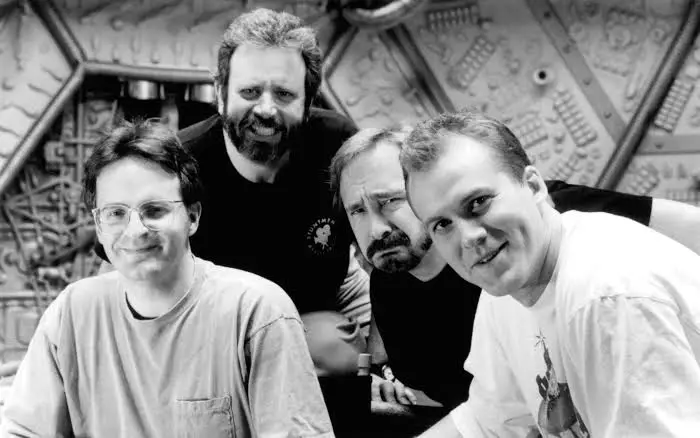
Because here’s the thing: Bruch didn’t actually look different, or worse, than any of the middle-aged white guys who made Mystery Science Theater 3000. He looks, in fact, like a human amalgam of producer Jim Mallon and original Crow T. Robot Trace Beaulieu. (Beaulieu’s got the chin.) He was just more vulnerable than they were, because he wasn’t hiding. All those other guys were behind the scenes, or underneath the puppets, or silhouetted against a movie screen, where we mostly couldn’t see their faces. The determining factor wasn’t Bruch’s looks: It was power. It was about who was available to be looked at and commented upon, and who had the privilege of commenting and looking.
No-one wants to be called ugly, especially not by someone they respect. It’s many people’s worst fear, in fact. Creativity, of any kind, is agonizingly vulnerable; everyone who does it has nightmares about doing it “wrong,” and the fear of making something “bad” and having its badness noticed stops many people from ever making art at all.
Yet it undeniably takes something to get out there, with your regular-guy carpentry-company-owner face, and make a movie, knowing that “ugly” is one of the many things people might call you. It takes a lot less to sit in the dark and call that guy names. Which one of those guys do you want to be: The person who takes a risk and creates something, or the person who stands over the creation afterward, pointing and laughing? Which one of them do you think is happier, or stronger, in the end?
As a teenager, I wanted to be the one laughing. I thought the great thing about MST3K was the commentary — people who were smarter than you, and funnier than you, and who were fed-up, just like you, with the absolute dreck Hollywood dared to call “entertainment.” I learned a lot from that voice — the whole Internet did; MST3K has arguably done more to shape Internet humor than any offline institution — and I’m grateful. The gift of MST3K, what Kevin Murphy once called “screaming back at the culture,” was that it asked you to be critical of what media served up to you. It told you to look for the holes in the official narrative, to value your own perceptions, to hold nothing sacred and laugh when the people in charge were laughable. Those are all good traits, and cultivating them led many of us, not just to the Internet, but to leftist or feminist politics (not that MST3K would necessarily lead you there on purpose; in ten seasons MST3K hired zero non-white writers, and only two women, one of whom was the head writer's wife).
Yet look around: In 2026, there’s a lot of screaming. The amount of screaming dwarfs the amount of culture there is left to scream at. Ben Shapiro is screaming at the culture; Jordan Peterson is screaming at the culture; Elon Musk is screaming at the culture; the President is screaming at the culture, and he is the culture, but he’s screaming anyway, because that's what gave him power. On the Internet, the posture of the smarter-than-thou, mean-but-funny dude (and it’s always a dude) who stands on the sideline and punctures everyone else’s bubble with his withering sarcasm (and it’s always his sarcasm) is ubiquitous, and not only on the left — Internet fascists, famously, prize “irony” because it lets them get away with increasingly literal murder.
MST3K made the Internet, but it also made the bad parts of the Internet; the conflation of cruelty with virtue, the belief that commenting equals contributing, the need for someone else on the Internet to be Wrong or Bad or Dumb so that we can get likes and clout and dopamine by coming up with the quickest, meanest, most widely shareable insult.
These forms of humor are dependent, secondary, parasitical; they require someone else to make something, be it a headline or a movie or a mistake, so that we can react. They divide the world into a hierarchy — the blithe, sincere idiots who actually try to do things, and the jaded observers on the sidelines who shoot them down.
It’s a pose that appeals to teenagers, because it makes you feel invulnerable, and teenagers are some of the world’s most painfully vulnerable people. Yet as you grow up, you begin to realize that vulnerability is not a flaw, but a prerequisite to doing anything meaningful; that it is only by putting yourself out there, bare-assed and bare-hearted and big-chinned before the world, that you can create anything at all.
You realize — I realized, anyway — that what makes MST3K great is the movies. If it were just a group of guys in a room talking over each other, there would be no show. It’s those “bad” movies — their big swings, their wild choices, their indelibly bizarre line reads and performances — that give the show its loopy, lo-fi oddball energy. Each of those movies is full of flawed, weird, irrepressible humanity, and humanity in art is always worth celebrating, especially now that it seems to be on the way out.
AI will make a thousand bad movies, but it will never make anything as silly as Time Chasers. It will never make Bride of the Monster, the first MST3K movie I ever watched, by the great Ed Wood. The climactic image of Bride of the Monster — a frail and elderly Bela Lugosi rolling around violently on top of a massive octopus puppet, because (famously) Wood stole an advanced animatronic from a movie lot, yet forgot to steal the motor that made it work, leaving them with a gigantic special effect that could only sit there while the actors attempted to look terrified — has brought joy to audiences for generations, with or without a bunch of guys talking over it. I will remember 71-year-old Bela Lugosi flailing on an octopus forever. I can’t remember any of the jokes any more.
I know what it’s like to be made fun of by Crow T. Robot now. I also know that it didn’t kill me. Most of us have more in common with Ed Wood or Matthew Bruch or even poor Mr. B. Natural than we do with Crow — most of us are human, and trying our best, and only occasionally succeeding. We are more likely to mess up or look like dorks than we are to have the perfect zinger. We look like carpenters, not film stars, but we still take off our shirts. We ask to be called “Mister,” even though we look like girls, and when those funny guys in the audience stage a host-segment debate about whether we’re “Man or Woman,” we’re the only ones not laughing. We are people, and we matter, and people have always mattered; will always matter; are the only thing that will ever matter in the long run.
Jason X is the best slasher movie — not because it’s good, but because it’s too busy having fun to care what "good" is. Jason X belongs with Bride of the Monster, with Time Chasers — with Chopping Mall, with She, with Beastmaster, with Class of 1999 and The Unborn and Leprechaun and Fear Dot Com — in the canon of great, crazed accomplishments that are just so much better than the majority of “good” movies ever will be. It’s a testament to the creative spirit — the same spirit that might make someone pick up a lacrosse mitt and a bowling pin and cobble it together into a puppet, cue up The Crawling Eye on a Midwestern cable-access channel and (why not? Who’s going to watch?) pretend the puppet is talking back.
That's the real lesson, the most important part of all this: MST3K, too, was an amateur production. It was a hobby, a lark, a low-budget unprofessional experiment in joy. In the beginning, there was no hierarchy of dorks and riffers, creators and commenters, clowners and corncobs; it was failures talking back to failures, weirdos talking back to weirdos, and it still can be, if you want. Voices fade, jokes become dated, heroes will disappoint you. As long as people make things for the fun of it, the show goes on.
Jason X is streaming on Tubi.
The spaceship is named for a song about queer sex, Michael.