Clayface: Digging Up the Dirt
The many Clayfaces behind "Clayface: Celebrity Dirt."
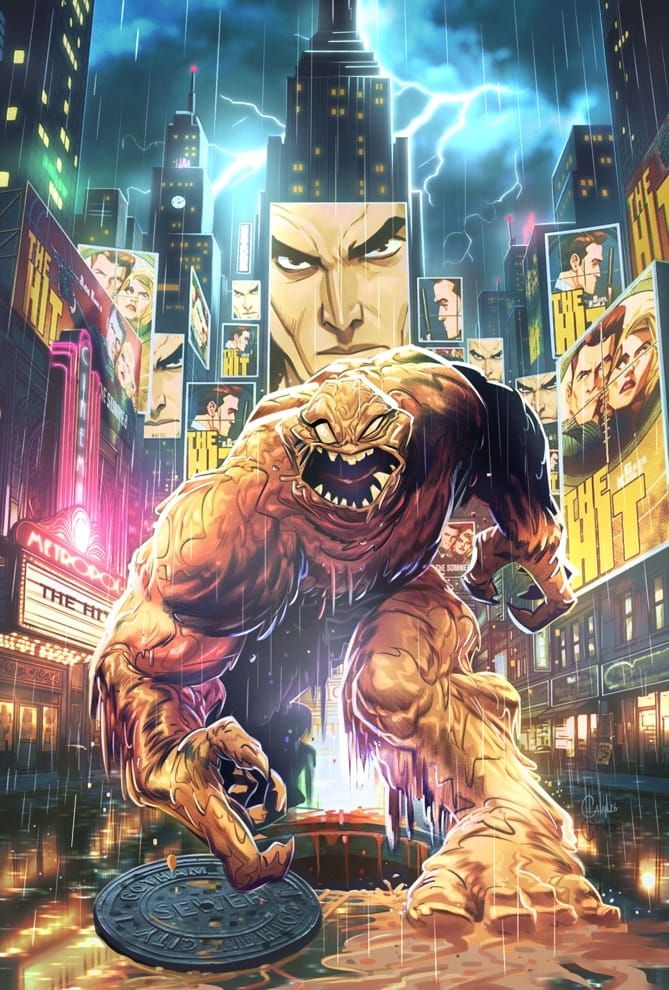
If there's one thing this newsletter needs, it's more project announcements. Lucky for you, this is a big one.
Clayface: Celebrity Dirt, a limited series with gorgeous and disgusting art from Fran Galan, is coming out from DC Comics this July, and I wrote it. You can find the official announcement here. You can find my less official blog post below this sentence.
The characters in superhero comics have a life of their own. They exist independent of any creative team that works on them — writers come and go, artists come and go, but Batman stays Batman.
Which is to say: I had never really worked on a superhero comic, before I pitched Clayface: Celebrity Dirt, and it was intimidating. You have to know, going in, that nobody will be buying that series because your name is on the cover; people buy a comic book called Clayface because they like Clayface, and they expect you to get him right.
Making matters worse, I didn’t know Clayface that well before I pitched. I was familiar with his look, and remembered him as a spooky villain on Batman: The Animated Series. But no-one had ever sat me down and said, so, Batman fights this guy that’s sort of like John Carpenter’s The Thing crossed with BoJack Horseman, and he’s sometimes a good guy, except when he really isn’t, and it’s all kind of a big metaphor for shame, and how, even if you can make yourself look like a person to the rest of the world, in your heart you will always know you’re a huge disgusting monster made of dirt.
Here is the thing, though: If you offer me the opportunity to write “John Carpenter’s The Thing infects BoJack Horseman,” I will crawl over broken glass to do it. The more I learned about Clayface, the more obsessed I became with the character, not least because every other obsession I’ve got — body horror; monster movies; fame and disgrace; addiction and recovery; who gets to “come back,” from which offenses, and the line between good and evil as it cuts through every human and/or mud-monster’s heart — existed inside this one sometimes-villain.
Goofy as it might sound, I saw a chance to do something intense and weird and emotional and even personal with this big IP project. I felt that Clayface, if he knew I wanted to write a script for him, would let me — he’s bigger than me, and will always be bigger than me, but of all the writers he’s had, over his 86-year-long life span, I thought my name should be on the list.
I also know that he doesn’t belong to me. I had to read all of those other writers to get him right, because Clayface is complicated. He’s less a person than he is a species — there have been at least eight Clayfaces, with varying abilities and backstories, and they’ve swapped and combined and recombined their superpowers roughly five jillion times, leaving the question of who is who and who can do what perpetually up for debate. Sometimes the same Clayface goes by different names, depending on which continuity he's occupying. When you pick up a comic called Clayface, you’re coming for Clayface, but there’s a very real chance that you don’t know which one(s) you’re getting.
Unraveling all that, and making a story about Clayface for people who like Clayfaces, takes research. Here, then, is a select (and heavily incomplete) list of the stories I drew from for Clayface: Celebrity Dirt.
“Feat of Clay — Pt. 1 and 2,” Batman: the Animated Series, 1992. This isn’t a comic, but it’s probably the single most influential Clayface story in the canon. Before “Feat of Clay,” there was Basil Karlo — a disgraced actor who wore a mask to take revenge on Hollywood — and there was Matt Hagen, a thief who committed crimes using his shape-shifting powers. Both of them were Clayface, but they were very different people. After “Feat of Clay,” there was only Matt Hagen: A disgraced actor who fell into a life of crime thanks to his addiction to a mysterious substance that gave him shapeshifting powers. (This same guy was “Basil Karlo” in the comics, just to make things difficult — I’ll be referring to him as “Basil” for the most part here.)
if that clayface movie anything like this ITS A 10 ALREADY THIS WAS CRAZY pic.twitter.com/aO7r4AqPrY
— marcus🇵🇸CEO of Teen Titans (@y2kmarcus_) June 9, 2025
“Feat of Clay’s” biggest legacy was that compressed and streamlined canon, but it’s also a really great, sad story about a man struggling with addiction while trying to keep his private face hidden from the world. What we show and what we hide; the people we try to be and the people we are when no-one's looking; one guy's increasing inability to just keep himself together: This is where great Clayface stories start.
“The Murders of Clayface,” Detective Comics #40, Bill Finger and Bob Kane, 1940. That said, the first Basil Karlo story — in which a washed-up star finds out that Hollywood is rebooting the movie that made his career, and starts slaughtering his way through the cast — is a lot of fun. (“You remember how after he became a big star he got into scrapes and did a lot of crazy things… after the papers got through with him, the people wouldn’t go to see his pictures even if they gave away prizes,” one character comments, making Basil Karlo perhaps the only man in Hollywood to face permanent consequences for wrongdoing.) Is it very obviously an attempt to insert horror icons Lon Chaney and/or Boris Karloff into a Batman comic? Yes. Is it sort of like Phantom of the Opera? Also yes. But that’s what’s great about it, and Basil’s seething hatred of reboots alone makes it worth your while.
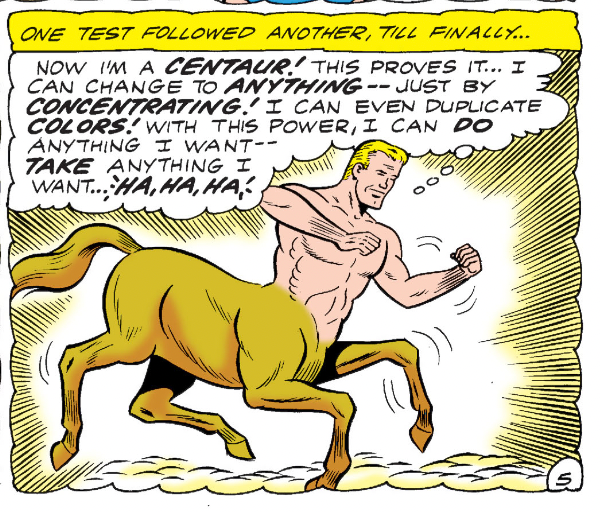
“The Challenge of Clay-Face,” Detective Comics #298, Bill Finger and Sheldon Moldoff, 1961. The first Matt Hagen story has…. not aged as well. It’s true that Matt Hagen’s crimes largely consist of turning into, say, a saw blade or a dragon, while yelling “I’VE BECOME A SAW BLADE” or “I’VE BECOME A DRAGON” just in case anyone missed it, but the rainbow pool of goo from whence Hagen derives his powers is a great visual, and the goofiness of it all is winning. Fuck it: I hereby vow that in Clayface: Celebrity Dirt, we will find out how a man commits the perfect crime by becoming a centaur.
“Mortal Clay,” Alan Moore and George Freeman, 1987 and Arkham Asylum: A Serious House on Serious Earth, Grant Morrison and Dave McKean, 1989. Both of the Big British Writers (or, as I call them, “BBWs”) from DC’s ‘80s renaissance wound up writing Clayface stories, but they both wrote for the darker and more body-horrific Clayface of that period, Preston Payne.
The third Clayface was a lonely scientist who injected himself with Matt Hagen’s DNA in hopes of becoming handsome, only to become a pile of hideous goo who melts any woman he touches. The trouble is that he can’t stop touching them; he’s afflicted with a compulsive “fever” that does not let up until he makes contact with human skin. Preston also predicts the AI Girlfriend Era when, in an attempt to assuage his loneliness, he falls in love with a mannequin.
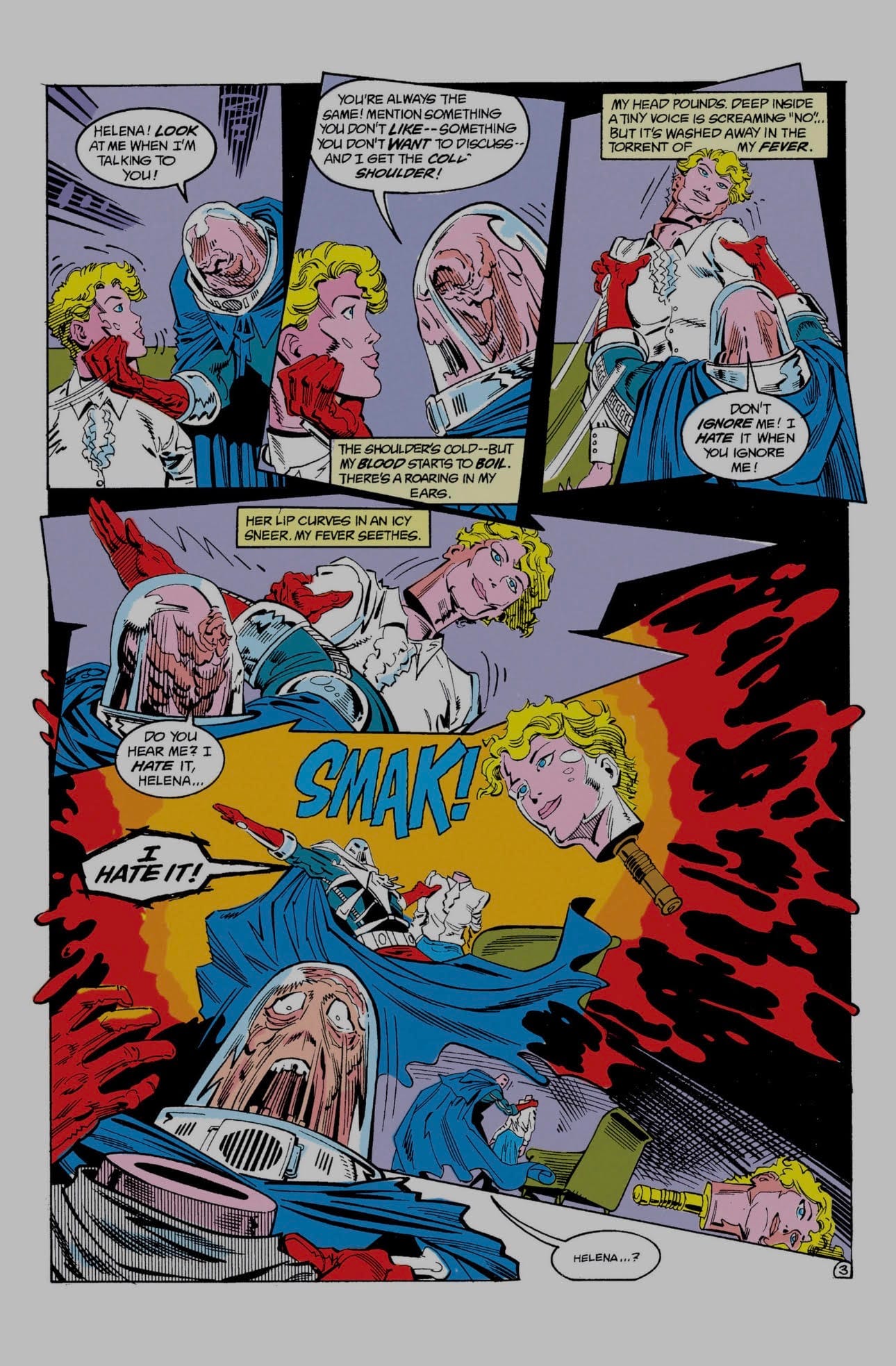
He also beats the mannequin up when she displeases him. Preston is not a well man.
Of the BBWs (a perfectly fine acronym! And one of my invention!) Morrison’s Serious House on Serious Earth is the more famous story. It only includes Preston for a few pages, and leans hard into the body horror — Morrison wrote that “alert readers will perceive [Preston] as AIDS on two legs,” an emaciated and lonely figure who only wants to be touched so that he can “share [his] disease.”
Moore’s “Mortal Clay” might be my favorite, though, not only because it shows Preston Payne running through all the stages of an abusive “relationship” with his mannequin — a very neat way of demonstrating that the responsibility for abuse lies with the abuser, not the victim, who in this case is a piece of plastic — but because its premise, a man romancing a mannequin in a mall after dark, is clearly a mean-spirited parody of the 1987 Andrew McCarthy/Kim Cattrall rom-com Mannequin, which came out a few months earlier. I watched that movie roughly 100 times on VHS growing up, and the thought of Alan Moore in a movie theater, on opening weekend, watching Mannequin, eating (let’s say) Skittles, fills me with joy.
“The Mud Pack,” Detective Comics #604 - #607, Alan Grant and Norm Brefogle, 1989. DC’s first real attempt to arrange and clarify what’s going on with all the Clayfaces, who, by this point, included:
- Basil Karlo, a disgraced actor scheming his way back into the limelight;
- Matt Hagen, occasional centaur (deceased);
- Preston Payne, a hideous goo-pile in love with a mannequin, and
- Sondra Fuller, a woman with severe body dysmorphia who hated her own face so much she was willing to let mad scientists give her Clayface powers to escape it.
There are several other Clayfaces in store, including Cassius (the eventual son of Preston and Sondra). But this is the first real attempt to get them all gathered around one table, and it gives Sondra a welcome showcase as she rustles up the long-retired Basil Karlo to help her take down Batman.
This story also resolves the eternal Matt/Basil conundrum by letting Basil inject himself with the DNA of all the other Clayfaces and (sort of) (kind of) gain their powers, thereby declaring himself the “Ultimate Clayface.” It’s not a real Basil Karlo plan unless he winds up dramatically making himself the center of attention by the end of it, although (reader, take note) he seems to be bullshitting: Out of all the powers he supposedly gained here, only the shapeshifting stuck.
Catwoman #1 - #4, Ed Brubaker and Darwyn Cooke, 2002. Several Clayfaces skated in and out of the DC universe after “The Mud Pack.” The most disturbing, to my mind, was “Todd Russell,” a serial killer who targets sex workers, and who assumes the identity of actor Todd Russell because he can’t remember his original human form. Violence against women has always been part of Clayface’s subtext — Preston beating up his mannequin; Basil killing pretty young actresses; Todd Russell isn’t even the only Clayface to prey on sex workers — but this story brings it into sharp relief by pitting Clayface against Selina Kyle. These women are her people; she knows them and cares about them, and that makes the nature of the situation — a man with power preying on women without it — painfully clear.
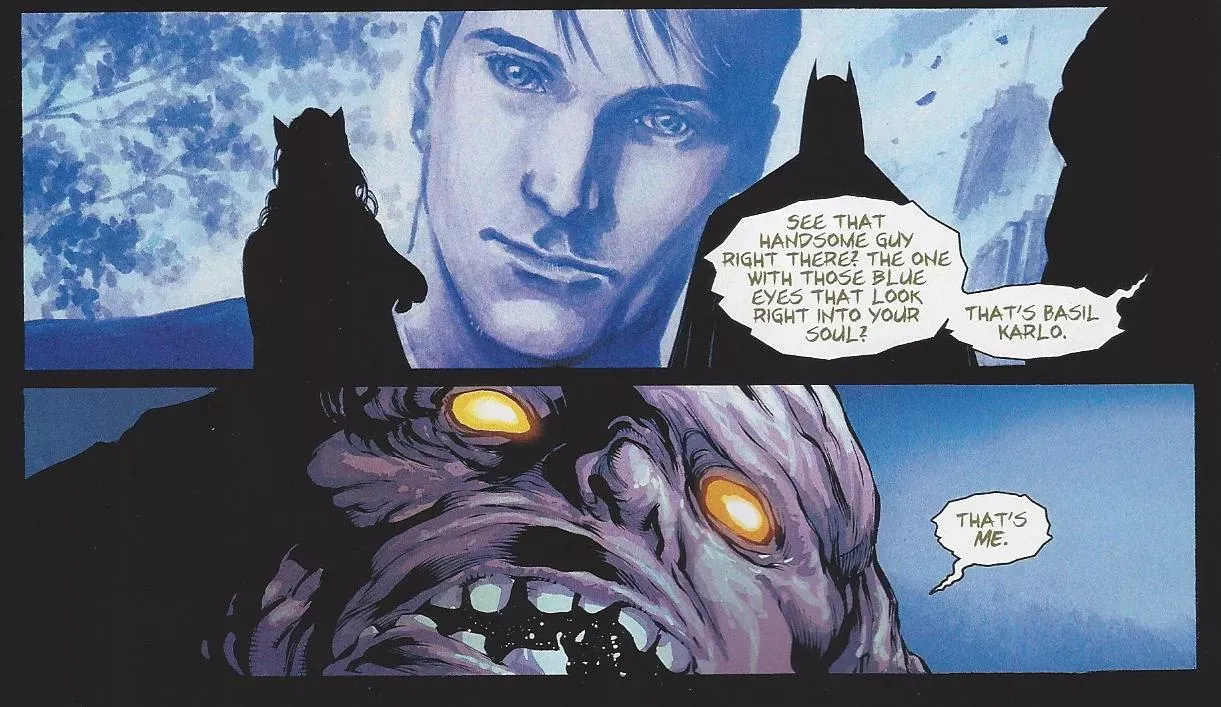
Batman: Detective Comics, Vols. 1 - 8, James Tynion IV and Alvaro Martinez Bueno, 2016 - 2018. This is where I fell in love with Basil Karlo. In his DC Rebirth run, Tynion gave Basil a face turn, and a core spot on Batman’s team, and in the process, took him from a metaphor or a Monster of the Week to a full person, with hopes and fears and loves and a whole life story he spends a lot of time regretting.
So many of the things I love about Basil — he’s book-dumb, but a great improviser; he has a strong inner Dad and a soft spot for young people in trouble; he giggles to himself whenever he fools people; he’s slightly too much of a narcissist to ever read the room; he knows both the best and the worst that he’s capable of, and even as he tries to be his best self, he knows that the monster in him will never be fully gone, nor will the damage he’s done ever be erased — come from this run. This is also where we meet Basil’s best-friend-and-possibly-more, Dr. Victoria October, a cane-wielding mad scientist whose vibe is “Dana Scully played by Katherine Hepburn,” and who frankly rocks.
Overall, I can’t recommend this run enough: It’s about accountability, about justice, about addiction and recovery, and there’s an issue about Basil’s relationship with his Dad that will make you cry. It’s an exceptionally tough act to follow.
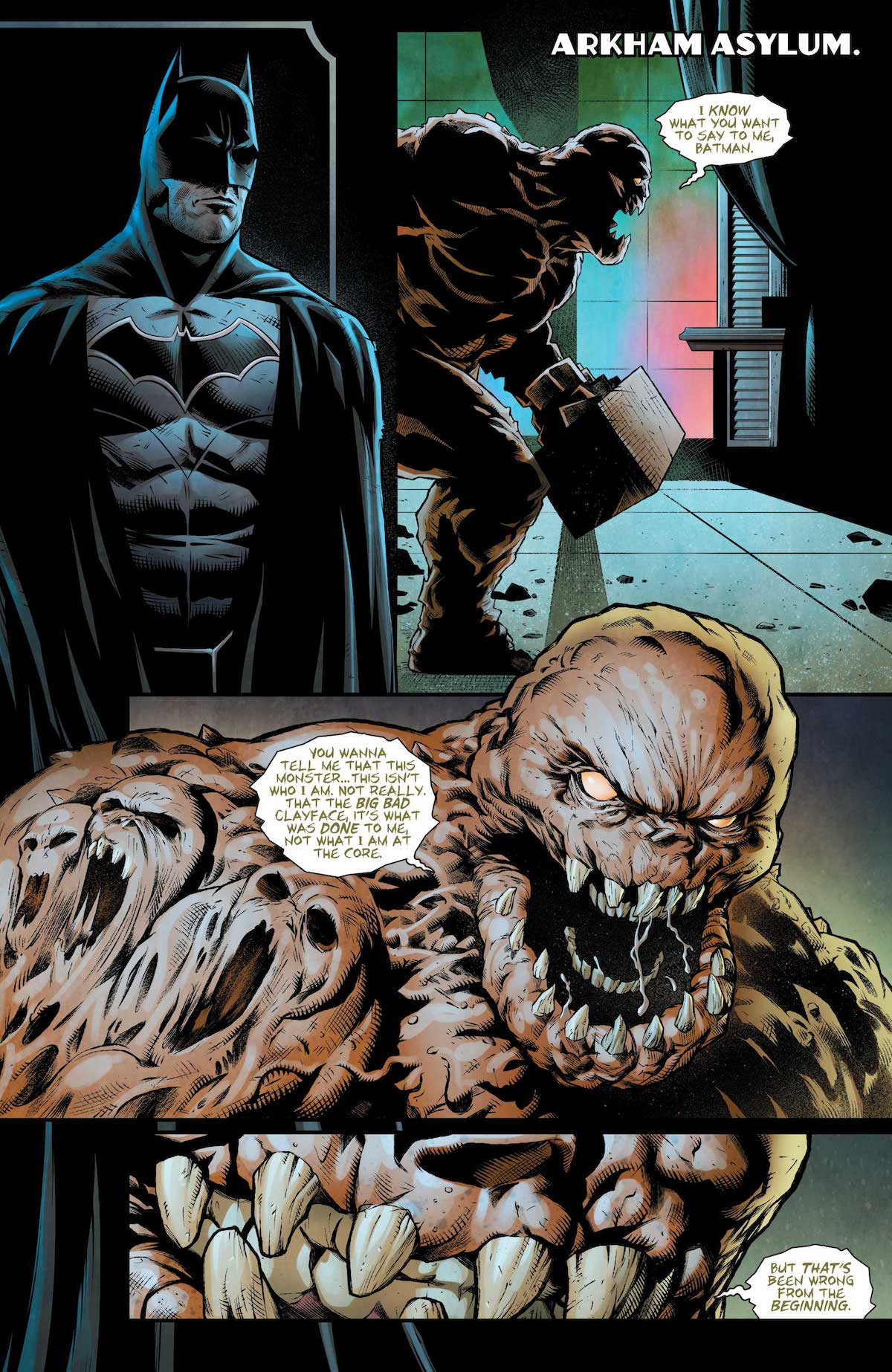
One Bad Day: Clayface, Colin Kelly, Jackson Lanzing, and Xermanico, 2023. Something always follows. For addicts, relapse often follows recovery. This one-shot follows Basil in Bad BoJack mode, lying, betraying, and finally just killing anybody that stands between him and his big comeback. Something about the presence and possibility of fame triggers this man and makes him capable of things he would never otherwise consider — no matter how well he’s doing, he flames out and becomes his most monstrous self when a starring role is on the line. (He is, as the story notes, hardly the only actor with that problem.) Tynion built Clayface up, and Kelly and Lanzing rip him right back down to rock bottom — and that’s where we find him when Clayface: Celebrity Dirt opens, still trying to make his way back into the light.
Clayface: Celebrity Dirt #1 will be out from DC Comics in July of 2026. The other comics are out already; read them while you're waiting.
Clayface is a creature of the movies, and I am a creature of the movies. If you want to take a look at some other inspirations for Celebrity Dirt, here's a Letterboxd list and a playlist to go with it.
Clayface: Tragic character, surprisingly upbeat playlist.