Children of God: My Own Private Idaho (Gus Van Sant, 1991)
Welp, it took me 30 years to be sad about this, and it will take me 30 more years to recover.
Clayface: Celebrity Dirt #2 is out now at comic shops and on digital platforms. Issue #3 will be coming on September 9.
In the meantime, you can pick up Be Not Afraid in collected edition; DILF in both book and smell form; and put in a pre-order for the collected edition of Dead Teenagers, due out October 6.
The year Speed came out on home video, I decided that it was important for me to watch every single film that had ever been made by Keanu Reeves. My motivations for this are perhaps best left unexamined. But there was one movie on the list that I wanted to see more than any other, and it was also the one movie forbidden to me: My Own Private Idaho.
I knew nothing about My Own Private Idaho, except that (a) Keanu Reeves was riding a motorcycle on the VHS cover, and (b) it was the reason my whole family thought Keanu Reeves was gay. I heard my aunts and uncles discussing it, during one of those big, buzzed family get-togethers where you hope that if you just hold your breath and stare at the carpet, they’ll forget that there’s a child in the room, so you can hear what they’re really thinking.
I heard what my family really thought of Keanu Reeves, and it was horrible. I love my family. Their stance on gay people has gotten better since the 90s, and much better since I came out. In the mid-1990s, however, hearing what my family thought about Keanu Reeves racked up at least a dozen future therapy sessions for Adult Jude. If I had a better or more flattering story to tell, I would tell it, but I can only say what’s true.
That conversation also taught me something, though, which was that Keanu Reeves — the man whose every filmed image I needed to consume, before the summer was out, in order to know peace — might be gay, and that there was a movie where I could watch Keanu Reeves be gay, in ways that were potentially indicative of real life Keanu gayness.
Granted: I was absolutely forbidden to rent this movie. But I had the image of Keanu Reeves on a motorcycle, and the prompt “Keanu Reeves gay motorcycle movie” to work with, and so the cursed little engine of my brain began whirring up its own simulation of what My Own Private Idaho might be like.
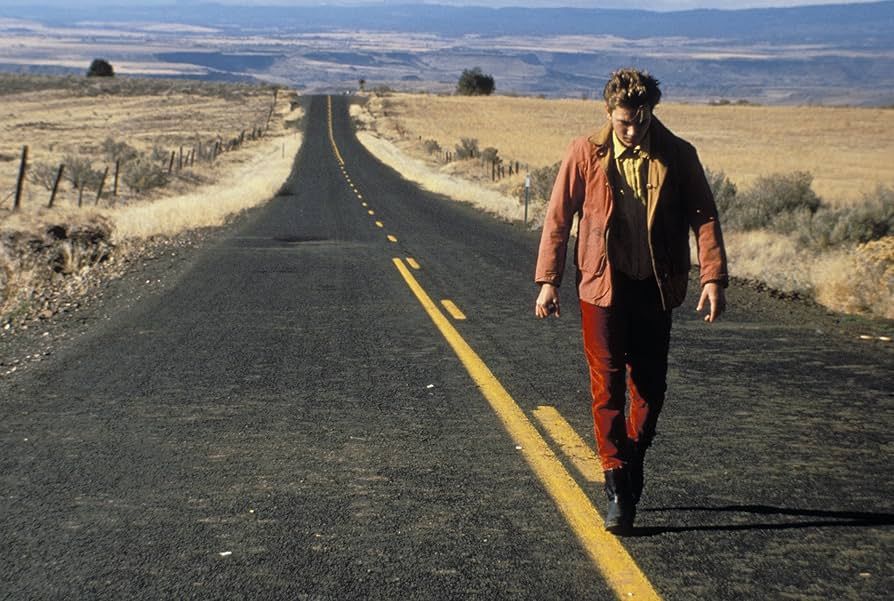
This second movie — my own private My Own Private Idaho — would be very slow and artful and Independent. There would be deserts in it, and lots of cinematography. Keanu would be on a long motorcycle journey with the other boy on the VHS cover, the blonde one, and they would be in love. I could not imagine what they would do with their love, other than ride motorcycles in the desert about it, but it would be very moving, and also Cool and Alternative. Watching My Own Private Idaho, even once, would make me a Cool person. I knew this for sure.
Well: Maybe it would have. Maybe that’s what went wrong, because the fact is that I did not see My Own Private Idaho until this summer. I had to rent it; it isn’t actually streaming anywhere, which is a hate crime. But I finally got an actual movie to compare to the one playing in my head. My first reactions, to the movie I spent my entire post-adolescent life planning to see, were as follows:
- Wait, it’s funny?
- Wait, Keanu isn’t the main guy?
And, most importantly,
- Wait. It’s a Shakespeare adaptation????
My Own Private Idaho is funny. It’s also a Shakespeare adaptation — Henry IV, to be exact — though only in certain scenes, and for a specific purpose that does not become clear until the movie’s final act. Neither of these things should distract you from the fact that it is a vastly, cavernously sad movie — a movie about what it means to be truly alone in the world, young and vulnerable and picked to the bone by human vultures, because there is no one who will just take you in, no-one who will protect you, no-one who will care.
The boy in this situation, and I do mean boy, is Mike Waters, played by River Phoenix. He’s a hustler — we meet him while he’s dissociating through a blow job from a man who is easily three times his age — who lives on the street. He’s cut off from his body and his sexuality by a history of abuse. He thinks it’s strange, and maybe shameful, that he’s attracted to men when he’s not being paid to fuck them. He had a mother, at one point, and he believes she would have held him and comforted him and told him he was good, but she disappeared (abandoned him, he refuses to say) when he was a toddler, and she was probably never who he thought she was, or who he needed her to be, even when she was around. Mike has narcolepsy, a condition that causes him to abruptly lose consciousness, often in dangerous situations. (Mike’s whole life is a dangerous situation.) We’re never told exactly how old Mike is, but scenes of him curled up watching cartoons at a client’s house underscore the point: This is all happening to a kid.
It sounds like the worst kind of trauma porn. But the movie has a miraculous lightness to it, which seems right — most people who have been severely traumatized don’t see their life as a tearjerking drama, they see it as their life, replete with good parts and bad parts and parts that are oddly normal. Mike’s vulnerability is never glossed over (one scene features several real sex workers, including the man upon whom Van Sant based Mike, relating their stories of being sexually assaulted on the job in excruciating and scarily blase detail) but it’s never allowed to circumscribe or limit his humanity.
Then, there’s Keanu. He plays Scott Favor, Mike’s best friend. He’s also a sex worker, but he does it with a safety net. His father is the mayor of Portland, and extremely wealthy to boot, and when Scott gets tired of being a “fuckup” (he’s set a deadline for his 21st birthday) he’ll go back home and inherit the family name and fortune. We don’t hate Scott for this; this is 1991-era Keanu, radiantly charismatic, a generational movie star about to break through, and he’s responsible for most of the movie’s buoyancy. But he’s just not in the same situation as Mike, and he never will be, and that’s where the Shakespeare comes in.
Whenever the movie’s focus switches from Mike to Scott, it becomes an adaptation of Henry IV. Scott is Prince Hal, the reprobate prince who spends all his time carousing with Falstaff (here, a guy named Bob) and other commoners (hustlers) and causing his father to despair over whether he will ever make a suitable heir. If we know Shakespeare, we know that Hal is destined to clean his act up and inherit the throne; we also know that the play is a lot more fun when he isn’t doing that.
Most importantly, we know that “Mike Waters” is not a character in Henry IV. The naturalistic movie that takes place outside those scenes — the ones where Mike searches for his mother, and nurtures his painful unrequited love for Scott, and slowly comes apart as adult after adult after adult tears a chunk off him and throws him back into the water bleeding — is completely irrelevant to the grand drama that Scott is starring in. Mike loves Scott, and Scott does love Mike, though not in the way Mike wants. (Scott, the one character in this movie who doesn’t need money, insists that he only has sex with men “for money,” and that “two guys can’t love each other.”) But there’s no way for them to end up together. They’re in different movies, and they have been from the beginning.
Scott is destined to use and discard Mike, too, because that’s what his story dictates. When he does, Mike will have no-one left. Not even himself, really, in the end.
My family, as it happens, was wrong about Keanu. If there was a “queer one” in the cast of My Own Private Idaho, it wasn’t him — it was the movie’s lead, River Phoenix.
I had no idea who River Phoenix was, when I overheard that conversation. I didn’t know anything about him for many years afterward. I’d never knowingly seen one of his movies before renting My Own Private Idaho; I must have seen him in Stand By Me, because my brother watched it 4,000 times growing up, but I never connected the name to the kid on screen.
So I didn’t know that Phoenix had sex with a man before filming My Own Private Idaho, in “preparation” for the role, or that he reportedly had sex with other men afterward. I didn’t know that, according to his live-in girlfriend, “if he loved somebody, male or female… he felt he should check it out.” I didn’t know that, when asked what he would say to people who thought playing gay might “hurt his image,” Phoenix answered, simply, “fuck them,” and spelled it out so the reporter had no chance of missing it. I didn’t know that the movie’s most famous scene — a straightforward declaration of love and a hug between Reeves and Phoenix, which feels tame by today’s standards but was shocking enough to spark outrage in living rooms across the Midwest in 1991 — was written by River Phoenix, and that he insisted on putting it in the movie. I didn’t know that he co-directed it; that it was the one thing he ever directed before he died.
That was what I knew him for: Dying. Two years after My Own Private Idaho came out, Phoenix was dead of an overdose. He was 23.
I mention this because, at a certain point, it becomes very hard to watch My Own Private Idaho without realizing that you are watching someone die. I don’t think any actor has been as vulnerable as Phoenix gets by the final act of this movie — you can see him wear down to paper, and then to nothing. Maybe it was that the process of being traded around between adults who saw him as a commodity was familiar to him, as a child star; maybe it was his experience of childhood sexual abuse, which he (like an alarmingly high percentage of child actors) shared with the character. Whatever allowed him to go this far into the character, the performance is so intimate that it becomes terrifying — he’s not acting so much as he is turning himself inside out. You’re not sure there will be anything left of him when the movie is done.
My Own Private Idaho was the movie where Phoenix began his final descent; he tried heroin for the first time while filming it. That method of self-destruction — the search for something that can numb you, and take you out of your body, perhaps permanently — feels deeply connected to Phoenix’s identity as a young maybe-possibly-probably queer man, and a rape survivor, in a world that relentlessly commodified his body and sexuality. (And, look, leaving aside the debates about posthumous labeling: When multiple people who knew the guy, including a live-in partner, say he had sex with and/or experienced romantic attraction to men, “queer” is a house big enough to hold that without imposing any false certainties.) The Children of God cult, where Phoenix was raised, actively encouraged sex with children as young as four — which is how old he was, when it started — but “male homosexuality” was considered immoral. What would it do to you, to believe that God condoned every horrible thing that had been done to you, but could not accept who you were?
I say this, as if I’ve never had to ask the question; as if queer people everywhere don’t have to ask it. This is a story that belongs to a movie star, but it also belongs to many, many guys whose names you’ll never know. It’s hard to watch this movie without feeling Phoenix’s death on the horizon, because that death feels like the logical endpoint of something he was trying to say with My Own Private Idaho. I’m hesitant to glamorize death by despair, or to say that “great art” depends on self-destruction, but every artist uses their trauma in their work. Sometimes it helps you refine your message. Sometimes you cut too deep and can’t control the bleed.
I recognize the place Mike goes, in this movie, because I have seen people get there — maybe I’ve even been close myself, a couple of times, but I always had a support system. I was one of those people, the lucky ones, who can count on a happy ending to be delivered, by the universe or by their families or (let’s be real) by whiteness and middle-class status and pure unearned privilege. I have seen what happens to people who don’t have those things. Not often, and they’re not my stories, but often enough to see this one kid’s face and get really scared.
In the final moments of My Own Private Idaho, Mike is alone, and seemingly on the verge of death (he has never not been on the verge of death) when some unnamed person picks him up and puts him in their car. It could be rape; it could be murder; it could be rescue. We’re not meant to know. But I’m telling you: I spent a lot of time at the video store, the summer Speed came out on VHS, and I would recognize Keanu Reeves anywhere. I don’t care if that’s not the answer. I’ve been making up My Own Private Idaho in my head since I was eleven years old. I’m allowed to make this up, too.
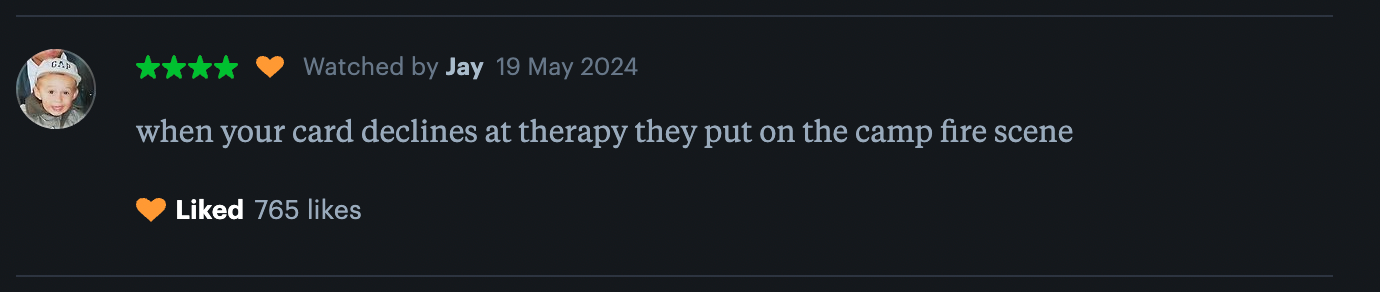
My Own Private Idaho is available to rent. As penance for being sad about something that everybody else has already been sad about for the past 30 years, here's a Letterboxd review that made me laugh for like five minutes.
Go hug your kids, if you have them. Jesus.